
Eric Abetz hands down 2026-27 Tasmanian Budget
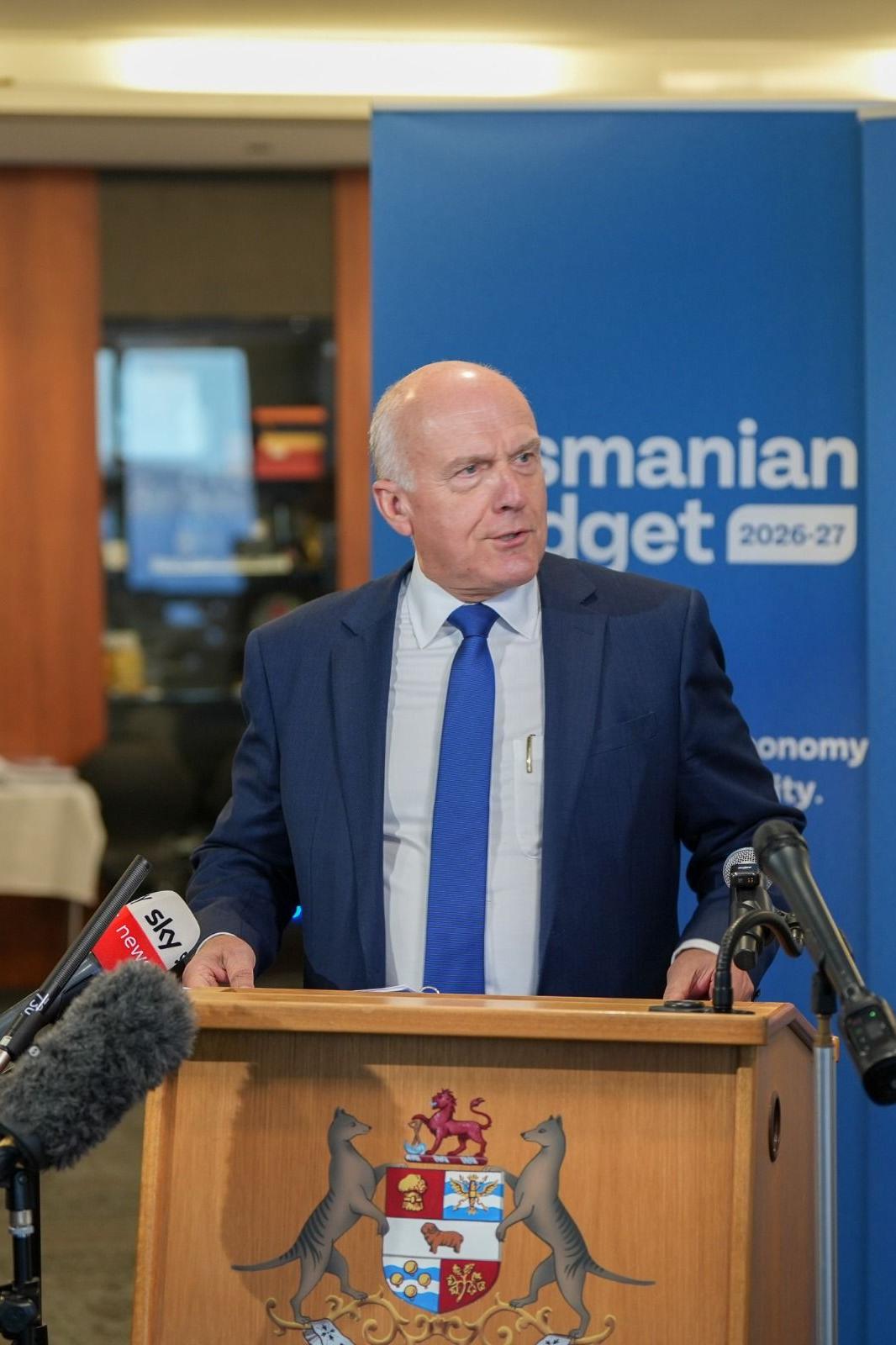
A return to surplus in two year’s time and “peak debt” of just under $10 billion being reached by 2028-29 headlines Tasmanian Treasurer Eric Abetz’s 2026-27 budget.
The surplus is achieved through aggressive spending cuts, including in frontline services such as health, public safety and education, which effectively holds the Tasmanian Government’s expenditure growth at zero over the budget and forward estimates period. Over the same period, revenue is forecast to grow at an average of just over 4.5 per cent per year.
This year’s budget forecasts a deficit of $596.7 million, rising to a surplus of $192.8 million in 2027-28, $436 million in 2028-29 and $622 million in 2029-30.
Over the budget and forward estimates, “efficiencies” in Health total $722.5 million, Education $228.2 million and $72.5 million in Police, Fire and Emergency Management.
Apart from a stated commitment to reduce the public sector by 1700 full time equivalents – without forced redundancies – there is scant detail on how these savings will be achieved, raising questions about how realistic the Treasurer’s financial plan is.
While there are no new or increased taxes, the budget papers announce a whole-of-government Fees and Charges Review, “to ensure charges better reflect the contemporary efficient cost of service delivery and modernise legacy charging arrangements”.
The budget contains relatively little new major spending, with the major new initiatives being the continuation of free public bus travel for another year at a cost of $16 million, as well as $28.3 million for the West Coast Wilderness Railway and a $66 million cash-injection to Events Tasmania over four years.
“Today’s Budget is the next and further step along the necessary course to ensuring budget sustainability,” Mr Abetz said.
“As the Good Book reminds us - there is a season for most things. There was a season for deficit budgeting. And now is the season for balancing the books.”
As flagged, the budget injects an additional $507 million in equity into the TT-Line, taking the total cash injection over two years to $582 million.
Despite this, the budget cautions that the level of funding provided to the TT-Line remains subject to ongoing risk, stating that “TT-Line’s equity requirements are based on detailed financial modelling that relies on a number of key assumptions”, and “if these assumptions do not eventuate, there is a risk that additional equity funding may be required”.
On the Macquarie Point Stadium, the budget confirms the current price of the new facility at $1.13 billion but notes that these costs are based on schematic-level designs and cost allowances, rather than market prices, and as a result “there remains a risk that procurement outcomes and detailed design decisions place upward pressure on costs as scope, constructability and market conditions are finalised.”
The budget also notes that requests for support in the major industrial sector present an ongoing financial risk to the State.
In 2026-27, defined benefit superannuation costs are estimated to be $397.5 million, with current projections showing that costs will increase by 19.5 percent over the next eight years, peaking at $475 million in 2034-35.
Interest on net debt is predicted to be $509.8 million in interest in 2029-30.
This year’s budget also introduces another new fiscal strategy. The new strategy targets, among other things, an improvement in the State’s credit ratings to Moody’s Aa2 (stable) and S&P AA+ (stable) by 2032-33.
THE 2026-27 BUDGET BY THE NUMBERS
Revenue $10,191.3 million
Expenses $10,788.1 million
Net Operating Surplus/Deficit $-596.7 million
Net Debt as at 30 June $8,440.3 million
Spending by purpose
Health 34%
Education 23%
Public Order and Safety 9%
Social Protection 7%
Housing 2$




Add new comment