
Fiona Hume fearful of losing family farm due to law enacted in 1869
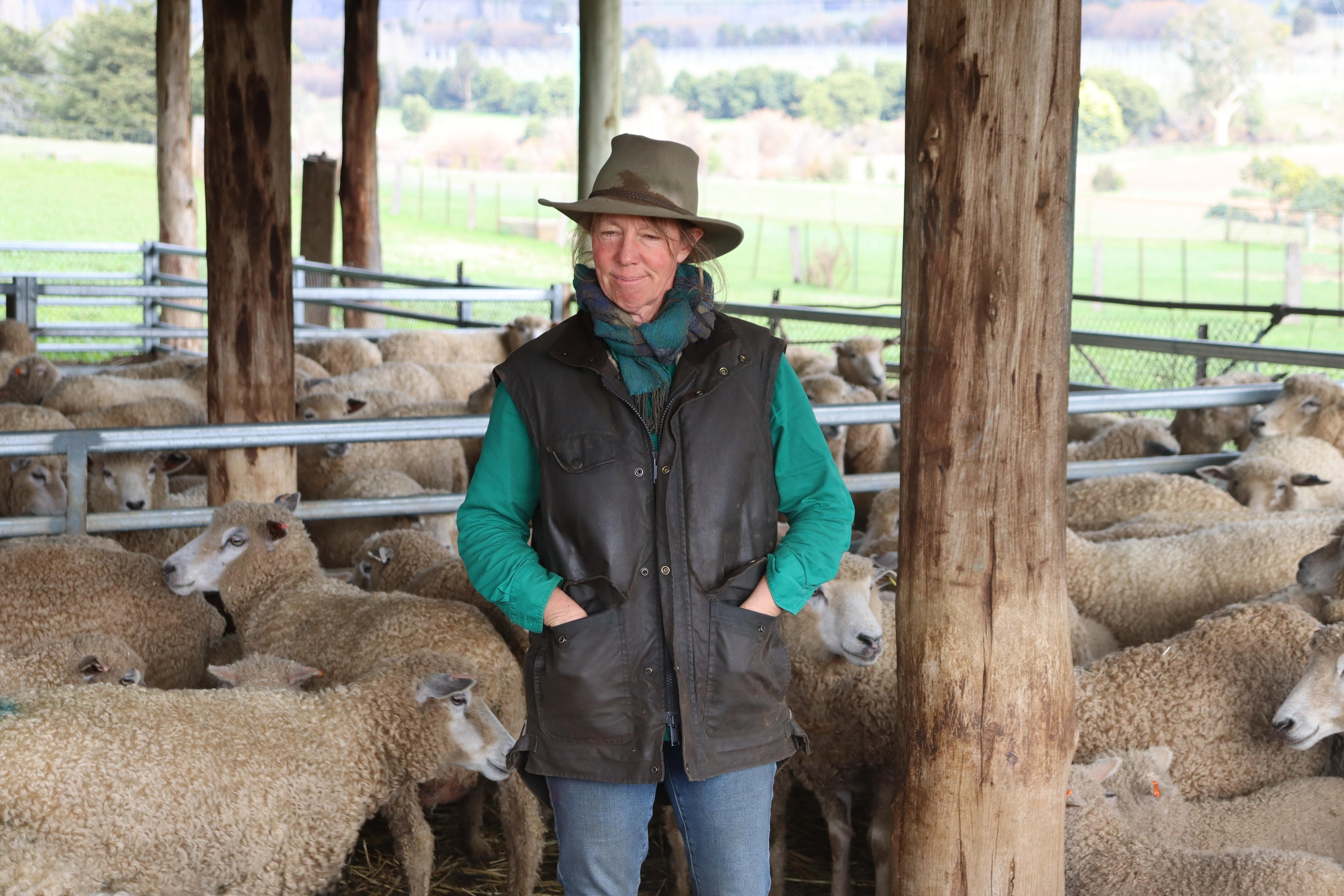
Fiona Hume is worried that a 157-year-old law could see her lose the family farm.
Arundel Farm, at Macquarie Plains in the Derwent Valley, has been in her family since 1894, but now Hansen Orchards managing director and owner Howard Hansen owns 30 per cent of the farm Estate after he bought the share from Fiona’s sister.
A Hansen Orchards property is right next door to Arundel Farm.
Fiona worked with her father for 19 years before he died in 2020 and has run the farm full-time since.
She said that her father left 30 per cent of the farm to her sister with the intention that Fiona would buy her out.
However, Mr Hansen purchased Fiona’s sister’s share in March this year.
Fiona said she had been trying to purchase her sister’s share for six years.
Mr Hansen’s share of Arundel comprises 30 per cent of the farmland and infrastructure, including Ms Hume’s house.
She says that she has never met Mr Hansen in person.
Under the Partition Act 1869, a minority co-owner of land can apply for jointly owned land to be divided or sold, even where the majority owner does not support the sale.
Ms Hume said the Act required urgent reform.
“This archaic law threatens the stability of family farms, the security of our state’s food production, and the viability of small agricultural businesses like mine,” she said.
“The Act allows any co-owner—no matter how small their share or how recently they acquired it—to force the subdivision or sale of jointly owned land.
“The Court has almost no discretion to consider the economic, social, or generational value of an operating farm.
“Tasmania cannot afford to lose its farms to 19th-century legal mechanisms that no longer reflect modern agricultural realities.”
One reform Ms Hume has suggested is a mandatory buyout provision.
“Majority farmers should have the right to purchase a minority share at an independent valuation before any forced sale is ordered.
“A clause should be inserted that stipulates that the Court cannot order a public sale of primary production land if the majority co-owners offer to purchase the minority share at an independent valuation.”
Ms Hume also said judicial discretion under the Act should be expanded.
“Courts should be empowered to consider the nature of the land use.
“If the land is a registered primary production business, the court should have explicit powers to reject a sale application if it would cause undue hardship to the remaining operators or dismantle a multi-generational business.
“A low-cost mediation phase should be required before any Partition Action or Act proceeds to the Supreme Court, preventing wealthy speculators from using high-court legal costs to bankrupt farming families before a trial even begins.”
TasFarmers CEO Nathan Calman said Ms Hume was in a peculiar predicament.
“Looking more broadly at the laws in Tasmania and around Australia, it is something that other states such as Victoria and Western Australia have recognised in recent times and made changes to protect landowners like Fiona from unplanned mechanisms that can alter farm ownership.
“While farm succession is always a challenge, I think that had Fiona’s family understood the potential ramifications of the way ownership of her farm was handed from one generation to another and the consequences of that, they probably would have made alternative decisions in the years gone past.”
Mr Calman said he was not aware of any other farms in Tasmania where the Act could come into play.
“This Act was probably designed more than 150 years ago to solve one problem of the day, and it probably wasn’t envisaged that it could be utilised or weaponised in a way that it has been to force the changing of land ownership.
“We think this is a matter that needs reasonably urgent review.”
A Tasmanian Government spokesperson said it had no plans to change the legislation.
“The Partition Act provides a legal mechanism for dividing or selling co-owned land when owners cannot agree, and all applications are determined exclusively by the Supreme Court of Tasmania.
“While the Government is not currently reviewing the Act, Land Tasmania will work with the Supreme Court to seek any further views.”
Mr Hansen was contacted but declined to comment.




Add new comment
Comments
A little unfair
I’m not sure if this article is intended to take aim at Mr Hansen, but it certainly comes across that way. From what’s presented here, poor succession planning seems to be more at the heart of the issue than the neighbouring farmer who legally purchased a share of the property.
The article doesn’t suggest Mr Hansen has actually attempted to force a sale, or even threatened to do so. In fact, it says Ms Hume has never met him. It also seems somewhat misleading to suggest that a 30% owner can simply force the farm to be sold — he can apply to the Supreme Court for a partition or sale, but that does not mean a sale automatically follows, and the Act also provides mechanisms for another co-owner to purchase the share.
There may well be more to the story, but based on the information provided, it seems premature to portray Mr Hansen as the problem when this appears primarily to be an unfortunate consequence of how the farm’s succession and ownership were structured. I’d be thanking him for what seems as though Ms Hume is living rent free in a house owned by him.
One side of the story
It would be interesting to hear from the family member that has been waiting to be paid out their share of the farm for the past 6 years. They may have a very different view of how this all played out. Definitely a succession issue from the sounds of it.