
Dung beetles improving on-farm outcomes
A five-year seasonal dung beetle swap with a South Australian beef farmer has been declared a success with Tasmania now the proud host of enough Bubas bison beetles to sustain its own population in the future.
Two North-West farms near Ridgley have been found to have bison babies and livestock producers are set to benefit as the population grows and spreads to deal with the excess dung right throughout winter when the Tasmanian beetles slow down.
Each winter, thousands of autumn/winter-active Bubas bison are sent to Tasmania, while our summer/autumn-active Geotrupes spiniger are sent to South Australia to cover its seasonal gap.
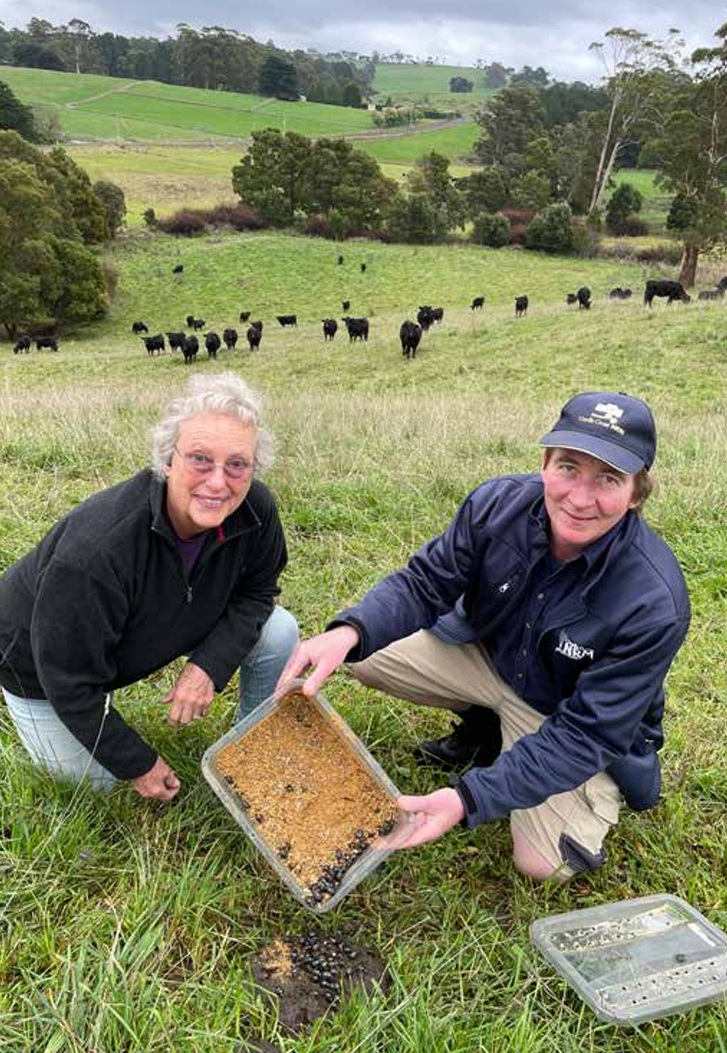
Cradle Coast NRM sustainable agriculture facilitator, entomologist and dung beetle expert Tom O’Malley last week released 8000 of the imported dung beetles across eight Tasmanian farms, including one on King Island.
Last summer he express-posted 11,000 of the local variety and personally delivered another 5000 to Matthew Robertson at Reedy Creek to distribute there and on neighbouring livestock properties.
Considering that 1000 beetles would cost close to $2000 to buy from a commercial supplier, and the latest batch from South Australia would be worth about $16,000, the exchange is mutually beneficial from both an environmental and a financial perspective.
“Ideally, Tasmania would have year-round coverage of tunnelling dung beetles to manage the large volumes of livestock dung produced each season,” Mr O’Malley said.
“Our dung beetle activity occurs mainly from summer through to mid-autumn, leaving a significant gap from early winter through to late spring.
“At the moment the Bubas bison has a very patchy distribution but this NRM project aims to solve that.”
The vast volumes of cattle dung produced by Australia’s livestock create a major challenge and a valuable opportunity for natural recycling.
Dung beetles are happy to feed on the faeces and break up the cattle pats by burying them - delivering nutrients and beneficial microbes into the root zone of pasture plants.
By doing what they do with doo doo, dung beetles reduce soil density and improve water infiltration, delivering significant benefits to both agricultural production and the environment.
“Dung burial also reduces fly breeding by limiting fly access to dung pats, helping to break parasite life cycles,” Mr O’Malley said.
“This can lower reliance on chemical controls, reduce pasture fouling and improve pasture productivity as well as helping reduce surface water runoff and limiting the amount of dung and faecal coliforms washing into rivers and creeks.”
In Tasmania, six of 13 introduced exotic dung beetle species have successfully established, however, their distribution remains uneven across grazing regions.
David and Perina Kentish at Glen Torrie Pastures, Wynyard, were one of the recipients of about 1000 bison dung beetles last week and Perina took great joy in finding them some fresh cow pat homes.
Since moving from New South Wales and buying their farm 24 years ago, they’ve worked hard to build up a quality black Angus herd while working on the sustainability of their land.
“This is the second release of dung beetles here and hopefully in a few more years this species will be well established,” Mrs Kentish said.
“It’s very satisfying to see some beetles in a cow pat and then a few hours later there’s just a flat bit of fibre left and it’s the soil that’s benefited.
“Dung beetles prefer the dryer marsupial dung rather than this wet cattle dung but the beetles cope with it and help us maintain our pasture.
Mrs Kentish said she’d learned to ease off on chemical inputs, not graze the land too hard and give it good spells to improve sustainability.
“If you look after the biology of the land the land starts to look after itself and the dung beetles are another way we can do that,” she said.



Add new comment