
Hall packed for Rushy Lagoon protest
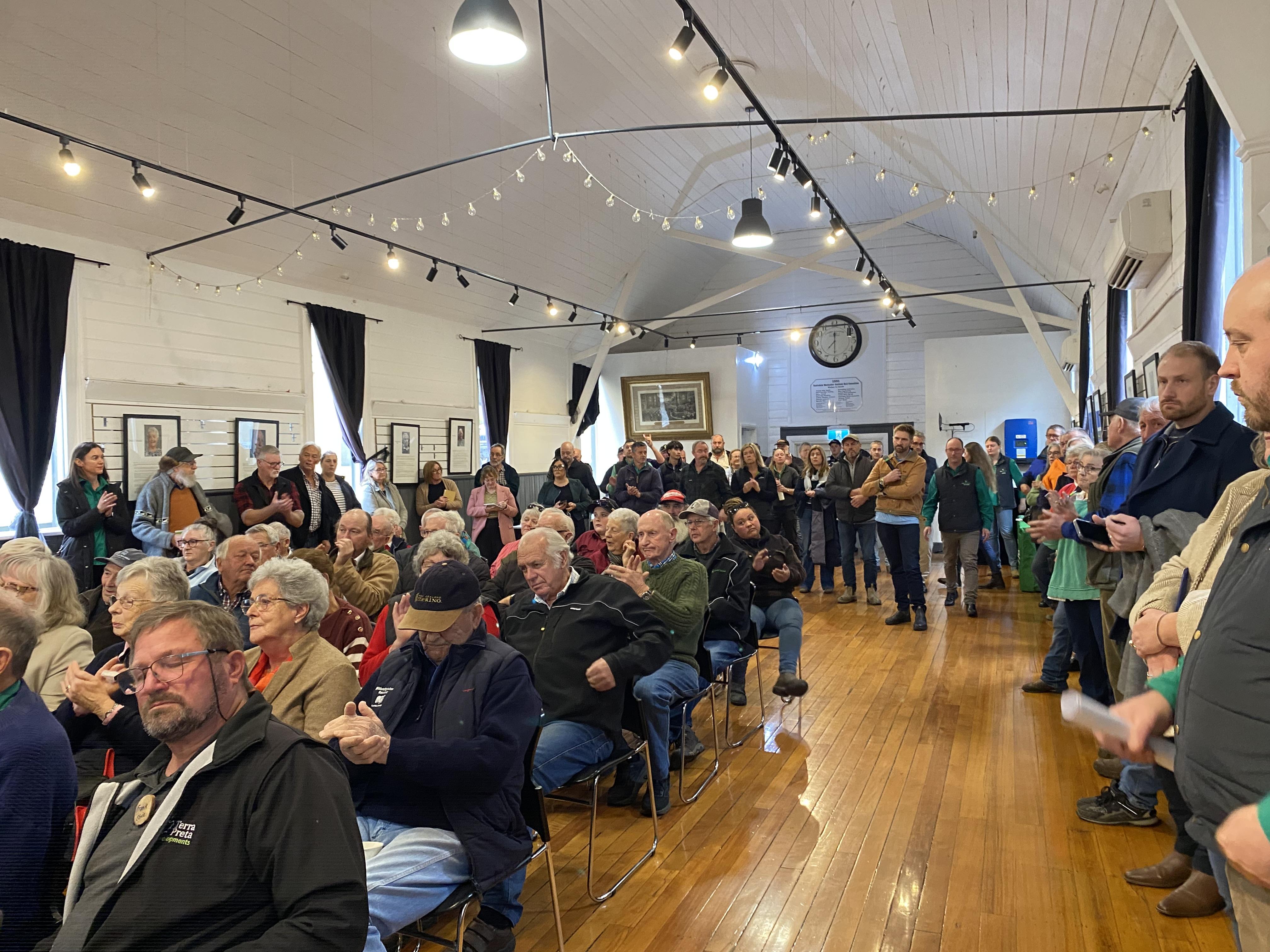
Tasmania’s north-east farmers not only railed against the federal government’s decision to sell 22,000ha farm Rushy Lagoon for a forest carbon project but at a TasFarmers-organised public meeting in Scottsdale this morning they put forward some strong reasons why the decision should be reversed.
Following an opening address by TasFarmers president Nathan Cox a panel made up of Primary Industries minister Gavin Pearce, North East Tasmania Chamber of Commerce president Fiona Auton, Senator Richard Colbeck, federal member for Bass Jess Teesdale and Dorset Council mayor Rhys Beattie put forward views to close to 150 attendees.
In the audience was Tasmanian premier Jeremy Rockliff, Liberal member for Bass Michael Ferguson, Shooters Fishers and Farmers member for Lyons Carlo Di Falco, former TasFarmers president Ian Sauer and Health, Mental Health and Wellbeing minister Bridget Archer, along with a broad mix of farmers representing forestry, dairy, beef and cropping enterprises in the north-east and other concerned citizens.
Those in the room reflected a recent TasFarmers survey that found that 98 percent of respondents were against the sale of Rushy Lagoon to the Tasmania Natural Asset Trust (TNAT), an investment platform managed by UK forestry giant Gresham House.
A show of hands resulted in 99 percent indicating they opposed the land use and would prefer to see it used for traditional farming enterprises that would contribute to the nation’s food bowl.
Admitting she was still trying to find answers to some questions, Ms Teesdale fronted the disappointed crowd and attempted to explain why treasurer Jim Chalmers approved the sale and why the Australian Government-owned green bank, the Clean Energy Finance Corporation (CEFC) invested $69 million of tax-payer money into the project along with shareholders Gresham House and Aviva Investors who jointly contributed $73 million.
Scottsdale resident Di Arnold, who along with her husband have farmed near Rushy Lagoon, said that no-one had successfully grown trees in that area.
“There’s only a shallow depth of topsoil and what is underneath the locals called native cement - a layer like sandstone that tree roots can’t penetrate,” she said.
She asked Ms Teesdale: what is more important, trees or food security?”
Ms Teesdale said that Australia is blessed with good food production but houses are needed too.
“The timber that will be planted here is needed for housing - we need both.”
Mrs Arnold said that the reason we have a sound agricultural economy is because of the people in the room who farm it.
“What we need is a government that is going to stand behind the farmers and protect their livelihood and that means giving them the ability to invest on a level playing field which is not what is happening here.
“We know that they’re not going to work, we know the land, it’s our land, and no-one in the community has been property consulted.
“We also need some sort of levels put in to protect us from these kinds of decisions - so we can say it’s not in our interest.”
Ms Teesdale said after the meeting that attendees had aired concerns that she had been hearing for some time.
“We desperately need investment in this region, it has to be the right investment and it has to go to the right priorities,” she said.
“We have an opportunity with Gresham, who is taking on this farm at no debt - it needs a lot of work and it wouldn't matter who took this on it has to have a lot of money go into it, it hasn’t been fertilised for a long time and the dairies haven’t been maintained well.
“We need to make sure that whoever takes on this property they have the money to be able to do it and they have those long term prospects.
“Now we need to make sure that our community will have a say in making sure that they’re local contracts and local workers wherever possible and I do think we have an opportunity in that.”
The new owners estimate that 190 new jobs will be created over the life of the project however TasFarmers refutes that, saying there will only be a handful of jobs after the trees are planted.
Mr Pearce said that it’s not too late to stop the project going ahead and quoted from the Australian Carbon Credit Union Scheme Plantation Notification Guidelines Section II.
“The agriculture minister may overturn a past decision or current decision resulting in a project becoming excluded under the offset process, such as when new information comes to light”.
TNAT will have a chance to answer questions directly from the public when it conducts information sessions about the Rushy Lagoon Project at the Gladstone Hall, 1 Carr St, on Saturday, July 25, 10am-3pm (1 Carr St, Gladstone) and again on the Sunday, July 26 at the Scottsdale Recreation Ground, 49B George St, 10am-3pm.
More information is available at www.greshamhouse.com/rushy-lagoon




Add new comment