
Wait for wool market to regain its Mojo
AS FAR as wool market corrections go this one thus far has been relatively mild with a 25% reduction of the increase we have seen since October last year, providing that is, that the market does now regain its Mojo and get back on the upwards train again.
So standing back and looking at the market movement over the past few months it is easy to see a typical pattern has emerged, even though it has been supply driven in the main and has not been instigated by an increase in demand as such. The market had a brief flurry in September which ultimately could not be sustained and then got serious about moving upwards in October.
That rally has seen around 70% added to the base price, so presumably not finished yet as a normal rally will add 100% to the underlying or starting price. Along the way it is perfectly normal to see a correction or two and these can be as large as 50% of the price action, but in this March correction, to date anyway, we have only seen a relatively mild correction of around 25%. Given that we have a smaller offering next week, then a one-week recess for Easter and then even smaller sales going forward the odds of the market regaining what it has lost over the past couple of weeks and then some is pretty good but time will tell.
The obvious rider to this outcome is the war in the Middle East which is starting to have negative implications for so many industries. The Australian market report was not great reading but many commentators reiterated the same point in that the buyers seeking the better wools are still having to compete strongly in order to get their share of the paltry volume of these types. The quality of the catalogues in general has decreased with low yields and higher vm the order of the day, along with a poultice of crossbred lamb’s wool. Overall the AWEX EMI decreased for the week by 27 cents in local currency terms, and 43 US cents.
Across in South Africa a very small offering of only 6,500 bales was a couple of percent cheaper with 12% of wool failing to meet grower reserves. Given that their season is drawing to a close with only 5,800 bales being auctioned next week the pressure of supply is likely to reassert itself fairly soon. Currency rates continue to fluctuate wildly in response to the conflict in the Middle East and risk appetite. Currently the AUD is trading below .69 USD which if maintained until next Tuesday would be supportive for Aussie Dollar prices, but that is a long way off. Of more concern is the energy price and its impact in different markets.
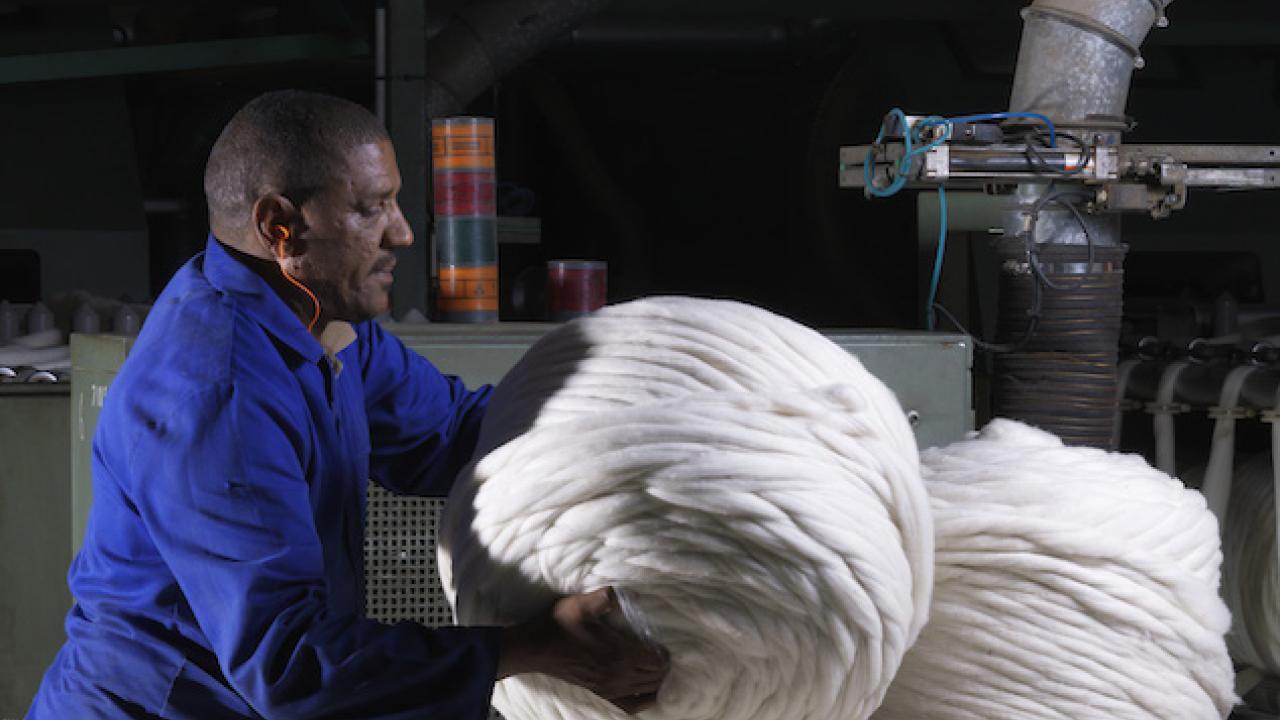
Fuel prices across Australia are rising on a daily basis and similar price trends are evident in Europe. Of particular concern for the wool industry is the cost of gas which is used to process wool. Unfortunately wool is an energy intensive fibre to process with heat required for scouring water and dryers are normally gas powered to dry the wool. Combing and spinning mills need to be airconditioned to maintain consistent temperature and humidity levels and the number of different machines the wool fibre passes through on its way to a becoming a garment all require electricity to turn them over. The dyeing stage is a very energy hungry operation with both temperature and pressure required and so a lot of processors in Europe are feeling a sense of Deja-vu. Energy prices are not yet at the extremes following the start of Russia’s Special Operation in Ukraine 4 years ago but the fear is building that they could get there.
Four years ago European mills produced some very expensive yarn, fabric and garments only to find that consumers either couldn’t afford them or just decided not to purchase in response to the rising inflation. Currently they are looking down the barrel of possibly a similar situation and so understandably have pulled the stop lever at least temporarily. Moving their production to ‘short time’ whereby the government provides assistance with labour costs is the easiest, most effective way to manage such a situation in the immediate term so a number of processors have taken this first defensive step. It will require a speedy resolution to the Middle East conflict if they are to resurrect business for the current season but the lingering inflationary effects will make it difficult to achieve.
In China energy prices are also increasing although less dramatically than in other countries around the globe whose supply chains are proving to be less resilient. The Chinese government’s obsession with building security of supply over the past two decades has clearly put them in better stead than some other prime examples and obviously some lessons can be or should be learnt from the Chinese example. Prices for all of the petrochemical based fibres are increasing in line with the price of crude oil but this is of little benefit to the wool industry. Retailers, at the commodity price level are still asking for more blends in their garments to offset the higher wool prices, but those blends are getting more expensive as the price of plastic increases, giving rise to further changes in composition.
Domestic business in China is reported to be difficult although more or less on a par with last year’s volumes. Expected uniform orders are not flowing freely yet but the second half of the year should see a large increase. So the push-me pull-you conflict remains on the horizon for the wool market with a smaller offering in Australia and South Africa next week, then a week’s recess and lesser quality offerings anticipated in both markets. On the other side of the equation is the large and growing threat of energy costs and perhaps an inflation induced recession which sows seeds of doubt in manufacturers and retailer’s minds around how much product they are likely to be able to sell this season. Next week will be challenging but there is potential for things to firm up, however the overarching factor will be the daily deliberations and utterings from Washington DC.
Damien Whiteley
Elders District Wool Manager



Add new comment