
Jean-Pierre Scheerlinck co-authors guide for novice beekeepers
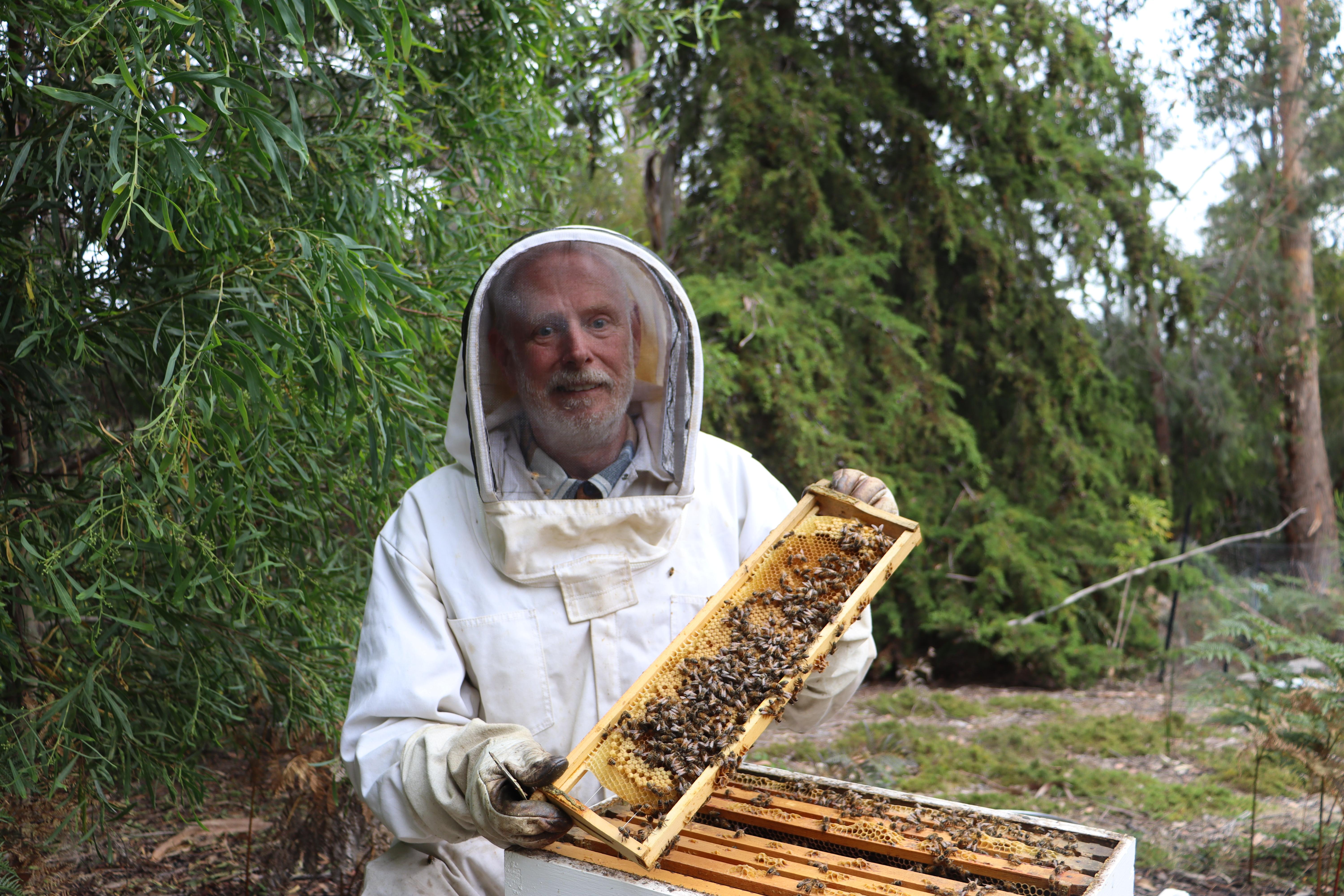
Jean-Pierre Scheerlinck is sharing his 20 years of beekeeping experience and research with aspiring apiarists.
The Huon Valley resident co-wrote the book Beekeeping Success with Robert Owen, one of his former PhD students from his time as a professor at the University of Melbourne.
It is Dr Scheerlinck's second co-authored book, following Honey Bee Pests and Diseases, which was published in 2022.
He said the new publication is a beginner's guide to beekeeping, with much of it written in a question-and-answer format.
“When talking to beekeepers, we found that very few would read a manual from start to finish and instead often used it as a reference book,” Dr Scheerlinck said.
“Everybody now will just ask ChatGPT, Claude or any other AI program.
“Yes, you will get an answer, but is it something you can rely on to actually implement, or is it something that AI has dreamed up?
“We thought it was important to have a reference book that had tried and tested methods to deal with a particular problem.”
Dr Scheerlinck said that once someone had the required equipment, beekeeping was easy to start.
“You can put a box there and leave it alone for many months.
“But people who are passionate about bees want to learn a lot more about them, and that’s where it can become very interesting.
“You can spend a lifetime learning new things about bees, their behaviour, how they respond to different manipulations, how you optimise things, and really understanding the biology of the bees.
“I’ve been keeping bees for 20 years and I am still learning.”
His journey with beekeeping began when he learned that a work colleague's father wanted to downscale his beekeeping operation, so he took over several hives.
Living in Victoria at the time, Dr Scheerlinck joined a beekeeping club.
“There were lots of people there who gave me advice, and it’s a lot easier to learn from other beekeepers than just to learn on your own through trial and error,” he said.
“From there, I started getting more and more interested in bee biology and went to the University of Melbourne.
“There was no beekeeping club at the university at the time, so I decided to start a beekeeping club for the students and staff.”
The club got permission to put hives on campus, and Dr Scheerlinck said they initially put them on the roof to keep the bees away from students and the public.
“I was part of the faculty of veterinary science, and when we merged with the faculty of agriculture, they were interested in using the hives for their own research.
“We worked together with some of those researchers to put hives close to their labs.
“They delegated the management of the bees to us, and they now have a bunch of amateur beekeepers that would maintain their hives, harvest the honey and do all the things that they didn’t want to do because they are focused on their research.”
Dr Scheerlinck moved to Tasmania in 2021 after taking a voluntary redundancy from the University of Melbourne.
However, he still holds an honorary position at the institution and still teaches beekeeping modules from his home at Waterloo via Zoom.
“I had to start from scratch when I moved here because you are not allowed to bring bees or any equipment from the mainland to Tasmania,” Dr Scheerlinck said.
“I found some local beekeepers and got some bees from them.
“I started with one hive and have built up to four hives.”
Dr Owen, who co-authored both books with Dr Scheerlinck, earned a PhD in 2020 after researching varroa epidemiology.
“He graduated around two and a half years before varroa came in, and a lot of the predictions that he made in his thesis – modelling showing what would happen – ended up coming true,” Dr Scheerlinck said.
“Since graduating, he has been teaching beekeeping in developing countries around the world, such as Nigeria, Lebanon, Cambodia and Nepal.”
Beekeeping Success is available to purchase online as a physical copy or an ebook.

Add new comment