
Tasmanian Mushroom Festival getting people hungry for fungi
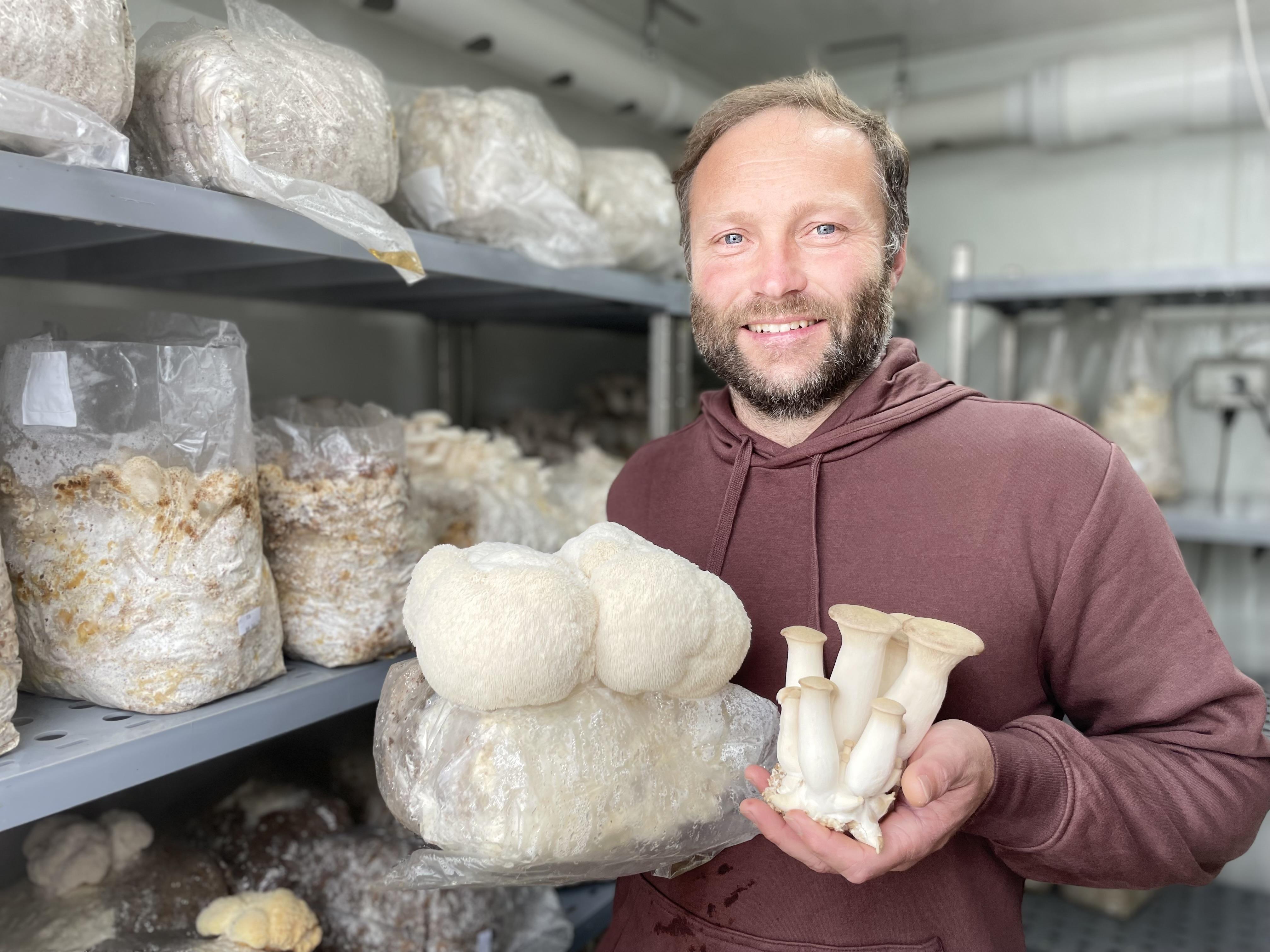
It’s been the week of getting hungry for fungi, with the Tasmanian Mushroom Festival connecting consumers with growers and combining mushroom food offerings with art, ecology and science.
Among the fascinating fungi-focussed experiences was a farm tour with Hillwood Fresh
Food Co’s Jordan Grieves, who has spent the past seven years developing his business on the east Tamar near Launceston.
The fully off-grid farm has Dexter cattle, a newly established egg enterprise and a shed full of mushrooms - all growing in unison and complementing each other.
More than 30 visitors to the farm on Sunday were walked through the mushroom-growing process, the pasture rotations, use of worm-powered bio stimulants and sustainable farming practices such as the chickens fertilising the ground to grow grass for the cattle, and then once grazed the chickens clean up the cow manure.
Jordan and his wife, Hayley Nielson, an occupational therapist, also did all the catering this year, delighting attendees with platters of local produce, home-made bread and tempura mushrooms - the perfect example of how small-scale, regenerative farming is shaping a better food future.
Living on nine hectares, growing food and raising two children is a lifestyle far removed from a former city life and working as a telecommunications rigger.
“I actually grew up on a farm but I didn’t want to be a farmer,’ Jordan said.
“It was a traditional farm where every year I saw the use of more fertiliser and more chemicals becoming a trajectory that was about expensive inputs and I just wasn’t into that,” Jordan said.
“I ended up working for Telstra building telecommunications infrastructure, which involved a lot of travel and time away from home, but when the two boys came along I realised that wasn’t a good fit for family life.”
The idea to become a mushroom grower was appealing to Jordan because it was relatively easy to get into, without a huge financial investment or a lot in the way of infrastructure.
When he started there were only a handful of growers across the state but that number has nearly tripled in a short amount of time.
“The mushroom market has grown but not at the rate I thought it would,” Jordan admitted.
“We sell to a few restaurants but Launceston’s Harvest Market is our main point of sale.
“The mushrooms that we grow are still in the niche category and not a staple - they’re bought as a treat and really, I thought they would become more mainstream.”
The Tasmanian Mushroom Festival is one of the ways that the industry is promoting itself, this year featuring a mushroom field day at BrewLab, Goodwood, where fungi was celebrated with workshops, food, science talks, kids activities, music, stallholders and photography.
Through collaboration with local producers, researchers and businesses, the festival is building each year with the aim of fostering connections, encouraging innovation and championing sustainability.
For the seasoned mycophile or those just beginning a journey into the world of fungi, the festival offers an opportunity to connect, learn and savour the wonders of mushrooms.
One of the highlights was the guided foraging adventures led by the editor of Tasmanian Geographic, Daniel Bar-Ness, which involved exploring and discovering fungi on Tasmania’s Kunanyi/Mount Wellington.
Jordan said he’s learned a lot in his first seven years in the mushroom business and for the second time has been happy to pass on his knowledge during the festival with a field tour.
He’s developed a supply of white, blue, yellow and pink oyster mushrooms, black pearl, king oyster, pioppino, golden noki and lion’s mane, with the oyster mushrooms making up the bulk.
Rather than scale up he’s become more efficient with the production process, having learned by doing - and trial and error.
He’s gone from buying in grow-bags to making his own from scratch, using the compost and worm wee from large worm farms, hardwood pellets and pelletised soy bean hulls in the substrate mix.
Around 20 to 30 kilos of mushrooms are produced on his property every week.
Being off-grid, the temperature isn’t always constant and the growth rate changes, with the harvest turnaround in mid-summer for oyster mushrooms being about 7-8 days compared to 10 to 14 in the middle or winter.
Value-added products from the mushrooms include mushroom powder as a flavour enhancer, mushroom salt, smoked mushroom salt and ready-to-eat meals such as mushroom lasagne, mushroom ragu, char-grilled pickled mushroom and a mushroom-based soy-type sauce.
The Grieves have 50 head of Dexter cattle that are processed and sold at the market and they’re slowly building their egg enterprise up to 450 chickens to further diversify and have another product to take to the market.
He’s also partnered with neighbour Jenni van Tienen who has come on board in the business and now takes care of most of the mushroom growing so that Jordan can concentrate on the newer ventures.



Add new comment