
New Victorian terminal for King Island cattle underway
A new Victorian livestock and freight terminal could eventually provide a direct mainland route for about 20,000 King Island cattle a year as well as general freight moving to and from the island.
Bass Strait Freight owner David Harris estimates King Island could account for about half of the 40,000 cattle a year eventually carried through the new operation at Port Anthony in South Gippsland.
The facility is being developed as a joint venture between Bass Strait Freight and the Anthony family, which owns and operates Port Anthony at Barry Point, Agnes, on Corner Inlet about 196km east of Melbourne.
Mr Harris says the new operation should be ready by the end of October.
The proposal is not new to King Island freight planning, with the Port of Grassy infrastructure review completed last year recording Bass Strait Freight as developing new berthing to support Port Anthony-Grassy services, as well as a proposed Smithton-Grassy-Port Anthony route.
Port Anthony itself is an established, privately-owned commercial port. The Anthony Group took ownership of part of the former ExxonMobil facility at Barry Point in 2001 and subsequently developed the Port Anthony Marine Terminal.
Mr Harris said changing cattle markets were behind the investment, with more young cattle from King and Flinders islands being sold as feeder stock into mainland markets rather than being carried through another winter.
In an ABC Radio interview this week, he said about 60 per cent of young cattle from the two islands had gone north during the past year.
Bass Strait Freight currently provides an “on request” freight and livestock King Island service, including movements from Grassy to Port Welshpool in Victoria.
The Port Anthony development is intended to provide a base for more regular services, as well as allowing freight to be consolidated interstate.
Mr Harris said that Port Welshpool did not provide the space needed to consolidate freight and it was not regarded as a long-term base.
The Port Anthony terminal will include a berth measuring about 50mx20m, around 1.5 hectares of freight yard and a 2000 square metre covered shed.
New cattle yards will have capacity for about 1000 head, allowing livestock to be fed, watered and rested after the Bass Strait crossing before travelling further by road.
Bass Strait Freight carries livestock in purpose-built pens aboard its vessels rather than in road trailers, making shore-based cattle handling and holding facilities an important part of the operation.
"If they're rested off the boat they're ready to travel as far as Dubbo," Mr Harris said.
Mr Harris described the development as a joint venture between Bass Strait Freight and the Anthony family.
He said the Anthony family had refurbished existing berthing infrastructure, carried out erosion works and developed a ramp, while Bass Strait Freight had developed the cattle and freight yards.
Mr Harris estimated the total investment at less than $1 million.
"We think that that'll probably double our business's turnover and ... change the way freight moves between the islands and the mainland," he said.
For King Island, Mr Harris said the project is potentially as significant for incoming freight as it is for cattle leaving the island.
Mr Harris said about 90 per cent of freight going to King and Flinders islands, excluding fertiliser and fuel, originated in Victoria.
"In our freight system we can take 250 tonnes out on the boat of freight when we go out to pick up the cattle," he said.
"So it makes sense that we can consolidate freight on the mainland."
He said Bass Strait Freight's research suggested a direct mainland service could reduce the cost of cattle and general freight by about 50 per cent.
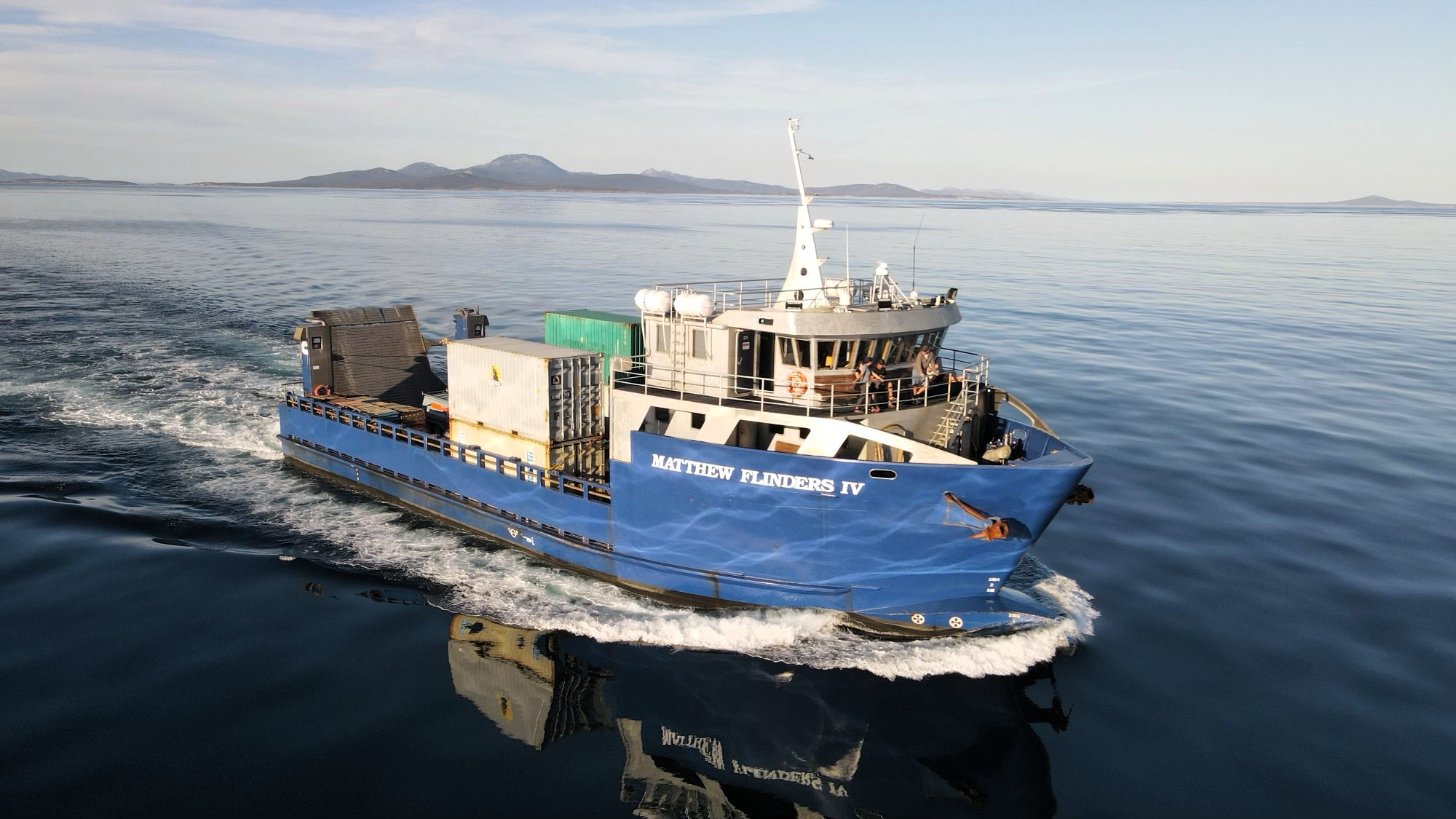
The company operates the Matthew Flinders III and Matthew Flinders IV, with the latter being prepared for livestock operations and expected to be based at Port Anthony.
Bass Strait Freight's website says the Matthew Flinders IV is also being extended to 45 metres, increasing its planned payload to 500 tonnes and livestock capacity to about 650 cattle.
Mr Harris estimated the new service could eventually handle about 40,000 cattle annually, with approximately 20,000 each from King and Flinders islands.
However, he stressed that figure represented an estimate rather than committed bookings from farmers.
"Look, there's no commitment," he said.
"If suddenly the value of young feeder cattle were higher in Tasmania, we'd be going to Tasmania."
The direct Victorian link has been under consideration for some time. Bass Strait Freight previously pursued an unsuccessful proposal for a direct King Island service through Apollo Bay before turning to other Victorian port options.
Flinders Island producer Nick Campion said another mainland route would give Bass Strait island producers greater flexibility when livestock needed to move quickly.
"It means that we've got another option, which is really exciting for livestock production on King and Flinders and Tassie," Mr Campion told ABC Radio.
"That diversification of transport systems is only going to help Tasmania."



Add new comment