
Locals miss the boat
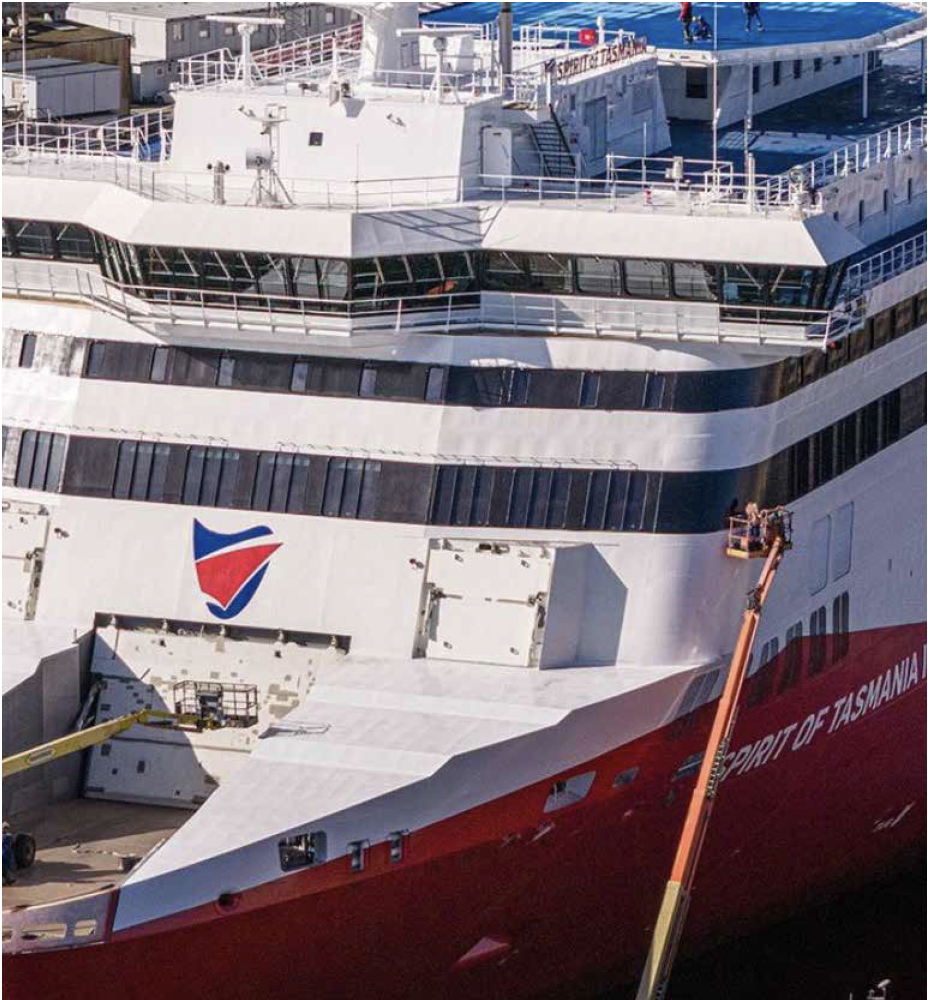
This past weekend, when the two new Spirit of Tasmania vessels finally started plying Bass Strait a mere $717 million over budget (an increase of 90 per cent on the original business case) and 1,765 days late, something was missing: the $100 million in “Tasmanian content” originally promised by then Premier Peter Gutwein.
While it’s true that the new ships feature Tasmanian products such as lifesaving equipment, blankets, artwork and table tops, the final local spend falls far short of the original $100 million promise. And that’s even when you count the vessels’ Finnish-built main engines, Apple iPads, UK-supplied gas detectors, Swedish cabin-key systems and Finnish security technology that the TT-Line farcically tried to claim as “local content” because they were procured through Tasmanian suppliers.
After the failed catamaran experiment of the late 90s and early 2000s, it’s reasonable that the TT-Line looked beyond Tasmania for the new ships. The truth is, despite the amazing world-leading manufacturing know-how of Incat, catamarans simply aren’t suited for the rough waters of Bass Strait.
What’s not reasonable is that after deciding to purchase new custom-made vessels rather than existing vessels, the company effectively thumbed its nose at the promise made by its political masters to include a significant portion of Tasmanian content (one-seventh of the original budgeted price).
Unfortunately, this is an all-too common problem with Tasmanian Government agencies and entities which, in a familiar form of “cultural cringe”, too often prefer big-name businesses from interstate and overseas rather than equally competent locals when filling contracts.
With total expenditure now reaching nearly $11 billion a year, the Tasmanian Government is our state’s biggest single player. And that’s before you add in government businesses such as Hydro, TasPorts and the TT-Line, accounting for billions more in expenditure in our local economy.
Concerned that too much of this money was going interstate and overseas, the Hodgman Government introduced a “buy local” policy upon its election in 2014 to require Government and their agencies to formally consider the benefits of locally owned and operated businesses in procurement processes.
The Government will tell you that this policy has been a roaring success. In reality, it’s been anything but.
Almost from day one this policy was bastardised by Treasury to minimise its impact. Apparently, we can’t risk upsetting the World Trade Organisation by favouring local business.
For competitive procurement valued at $100,000 or more (there’s the first problem, for under $100,000 the Government can do effectively whatever they want, witness the $95,000 awarded to the JackJumpers coach to now be some sort of “Biosecurity Ambassador”), a mandatory Economic and Social Benefits Test applies, with local economic and social benefits carrying a 30 per cent weight in the overall tender evaluation.
Contrary to popular understanding, this doesn’t mean that local businesses could be up to 30 per cent more expensive and still get the work. Far from it: it means 30 per cent of the total evaluation is dedicated to the bid’s local economic and social benefits. This test is meant to consider whether the supplier is a Tasmanian SME, employs a Tasmanian workforce, will use Tasmanian subcontractors, has invested in the Tasmanian community, and will source Tasmanian-produced goods and services.
The problem is, this test is easily gamed by big interstate businesses with the resources to do so, and a compliant Tasmanian bureaucracy too often taken in by the spin, flashing lights and gold name-plates from across Bass Strait.
It’s not hard for an interstate business to tart up their proposal with claims about local employment and business benefits. For example, a Tasmanian business registration, a leased shopfront, or a small number of Tasmanian employees, while the company’s ownership, management, workforce, supply chain and profits remain substantially interstate.
One of the worst forms of tender gaming is for an interstate business to claim to have entered into arrangements with local businesses where these businesses will also somehow ultimately benefit if they are awarded the tender. Too often these so-called arrangements turn out to be little more than promises which are never delivered. Meanwhile, the genuine locally owned business misses out.
And even if a Tasmanian business does come out on top on this assessment, perhaps even on top on price, with 70 per cent of the tender still up for grabs outside of the Economic and Social Benefits Test, reasons are too often found by bureaucrats in favour of the interstate business, instead of the local one.
Last week, jaws dropped across the local small business community when it was revealed that the unsuccessful bidder for the Macquarie Point Stadium would be compensated to the tune of millions of dollars for their tender work. In contrast, unsuccessful Tasmanian businesses invariably receive a form letter and the offer of a debriefing where bureaucrats who have never run a business essentially insult business owners by telling them why, compared to their mainland counterparts, they don’t know how to run a business.
Fixing this doesn’t require a new policy. It requires the existing one to mean something.
First, extend Buy Local to government businesses. The biggest local-content failure in recent memory, the Spirits, happened at a state-owned company the policy doesn’t even cover.
Second, make local-content claims enforceable. If a interstate bidder wins on the strength of Tasmanian jobs and suppliers, those commitments should be written into the contract, reported on, and carry penalties when they aren’t delivered.
Third, report local spend by dollar value, not by the number of contracts. A thousand small contracts to locals means little if the big ones keep going across Bass Strait.
Tasmanian businesses aren’t asking for a handout. They’re asking for the rules we already have to be applied as intended.
- BRAD STANSFIELD was Chief of Staff to Will Hodgman as Opposition Leader and Premier from 2010 to 2018, and is a co-owner of this newspaper.



Add new comment