
Tree Planting projects at Scottsdale and Exeter High Schools
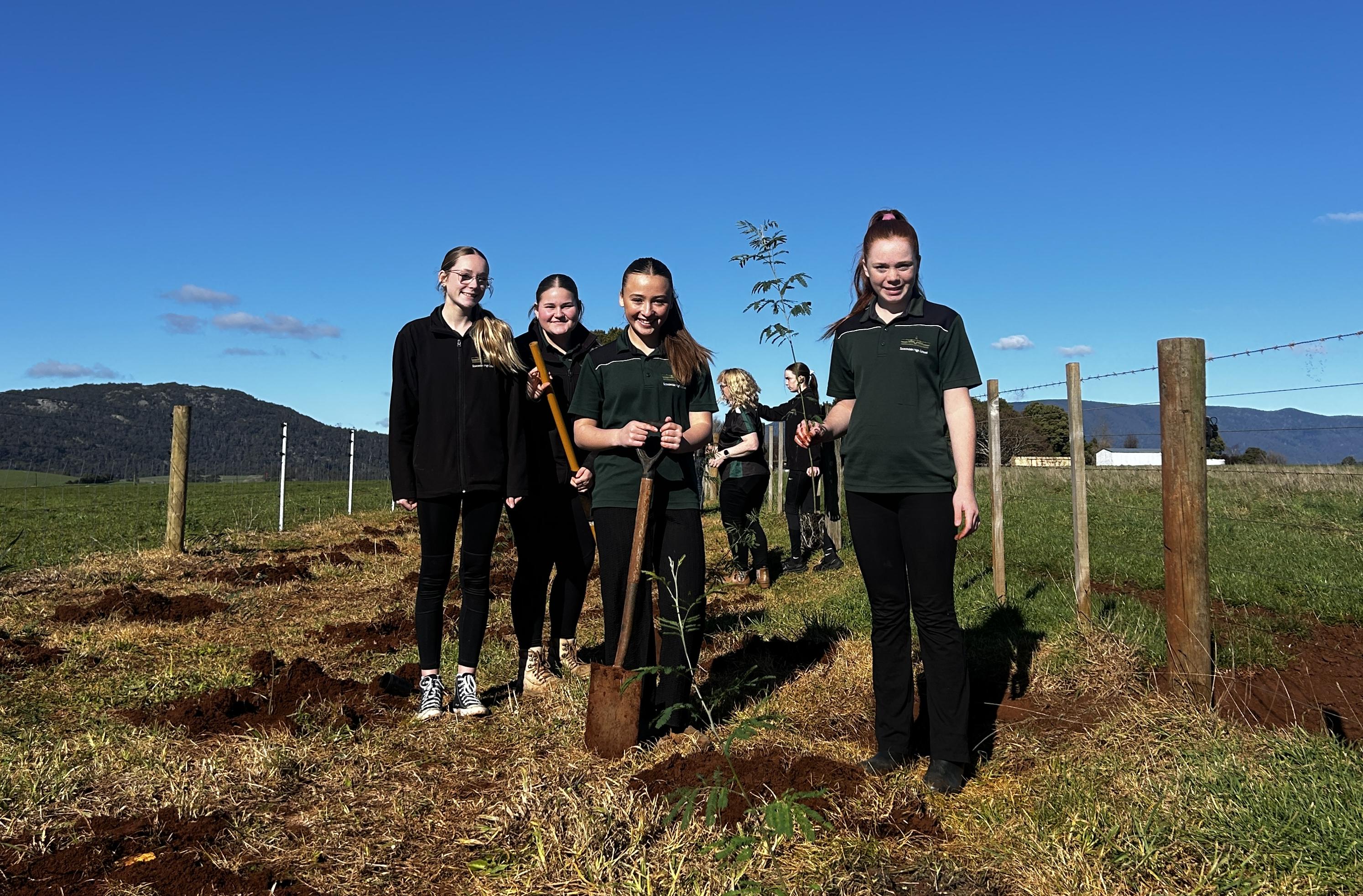
For the past 20 years, Scottsdale High School Farm has steadily transformed its landscape through a series of tree planting projects designed to improve animal welfare, protect the environment and provide students with valuable hands-on learning experiences.
Agriculture teacher Kylie Rattray said the school’s commitment to revegetation has grown from a number of significant community projects, including the Queen’s Jubilee Tree Planting, initiated by Liz Stanfield, and several National Tree Day events supported by the Forest Education Foundation (FEF).
“Each project has taught us something new,” Ms Rattray said.
“Every shelter belt we’ve planted has improved not only the farm but also the learning opportunities for our students.”
One of the school’s earliest projects involved establishing a diverse Tasmanian native shelter belt featuring a wide range of locally indigenous species. More recently, students planted a shelter belt along one of the farm laneways to address a persistent erosion problem.
“Cattle were continually tracking across a steep bank as they moved to the cattle yards, causing significant erosion,” she explained.
“We fenced the area to keep stock on the existing laneway and planted lower-growing native shrubs, including Ovens wattle and tea tree species.
“The results have been fantastic. The erosion has stopped, and the shelter belt now provides an attractive display of bright yellow flowers each spring.”
This year’s National Tree Day project focused on the farm’s western boundary, where students established a new three-row, 150m shelter belt. The planting consists of two rows of blackwood trees with a front row of Ovens wattle to provide both shelter and biodiversity.
In total, students planted 210 trees, each protected by a guard to shield young seedlings from wildlife and harsh weather conditions.
Ms Rattray said that what makes this year’s project particularly special is that every seedling was propagated by students at Scottsdale High School.
“Rather than purchasing seedlings, we’ve collected local seed and grown every tree ourselves,” Ms Rattray said. “It’s something we’re incredibly proud of because students experience the entire process – from collecting seed through to raising seedlings and finally planting them out on the farm.”
The school plans to continue this approach by involving future students in seed collection and propagation, creating an ongoing cycle of learning while reducing project costs.
The Forest Education Foundation has continued to play an important role by providing expert advice, planning support and technical guidance throughout the project.
“The expertise they bring is invaluable,” Ms Rattray said. “As teachers, having access to experienced professionals helps ensure these projects are successful and sustainable.”
Over two decades of tree planting, Ms Rattray has learned several valuable lessons that now shape every revegetation project at the school.
“The biggest lesson is that preparation is everything,” she said.
Early shelter belts were protected by simple electric fencing, which proved vulnerable during power outages. Curious calves were quick to find weaknesses and enter the planting areas, causing damage to young trees.
“Now we invest in proper mesh fencing with electric wires. It costs more initially, but it protects the significant investment made in fencing, tree guards, seedlings and countless volunteer hours.”
Other practical lessons include installing access gates for future maintenance, thoroughly preparing planting sites by controlling weeds, and ripping planting lines to improve soil conditions before planting.
“Good preparation gives young trees the best possible start,” she said.
Maintaining shelter belts is equally important. Regular weed control, blackberry management, grass suppression and the timely removal of tree guards all contribute to healthy tree establishment. Wherever possible, reusable guards are collected for future planting projects, helping reduce costs and waste.
Beyond the environmental benefits, Ms Rattray believes the greatest success has been the opportunity for students to develop a long-term connection with the farm.
One Year 12 student recently reflected that she had participated in every major tree planting project during her time at Scottsdale High School, beginning in Year 7 with the laneway erosion project, followed by the Queen’s Jubilee planting, and now this year’s National Tree Day shelter belt.
“Seeing students involved across several years is incredibly rewarding,” Ms Rattray said. “They can see how the trees they’ve planted have grown and understand the lasting impact they’re making.”
Around 25 students participated in this year’s planting, averaging approximately 10 trees each.
Meanwhile, only thing growing faster than the teenage agriculture students at Exeter High School are the shelter belt trees at the school farm.
For the grade 7 students involved in the recent second planting of trees on the farm, by the time they leave in grade 10 the little seedlings will be around four metres tall and the older plantings around eight metres.
Ag students from grades 7 to 10 and VET students studying a Certificate I and II in Agriculture were all involved in planting a new shelter belt – the second on the farm.
Pines, nitens and a good mix of native species came from Forico’s Somerset Nursery and it was all hands on deck to get them in the ground and install tree guards with the assistance of the West Tamar Landcare Group.
Forico nursery manager Lachie Girschik said it was easy to see how much better the grass was growing that had been protected by the previously planted shelter belt.
“Projects like these are a great opportunity to get students thinking about the future and how to manage the land and waterways as well as explore the value that forestry has as an industry and the many career options it can provide,” he said.
Exeter High School acting principal Jacquie Everson said: “Even on a wet day like today they’ve loved being outside for this project and not only is it an important part of our VET students gaining their qualifications but for our younger students it piques their interest in continuing in agriculture.”
Ag science teacher Jamie Pullen also fired up the deep cone biochar kiln, purchased last year with a $10,000 grant from NRM North.
“Biomass from things like tree prunings are normally treated as waste and left to rot and go back to the soil but with this kiln we can make pure carbon which, when added to our gardens or paddocks, acts as a sponge to take in water and retain the right moisture levels for plants to access when it doesn’t rain.”



Add new comment