
Trial plot of haskap berries growing at karoola
In a frosty paddock at Karoola an unusual plantation is loving the cool climate.
A trial plot of haskap berry bushes are coming along nicely, accumulating the required minimum 800 “chill hours” so that they can break dormancy and flower and set fruit in the spring.
The haskap berry (Lonicera caerulea) is a member of the honeysuckle family and is sometimes referred to as the blue honeysuckle – haskappu berry in Japan, haskaps in Canada, camerise in Quebec and honey berry in North America.
The name Haskappu means 'little presents on the end of branches” and most people who try them say they taste something like a cross between a raspberry and a blueberry with a hint of black currant.
The berries are a business project for horticulturist Darren Breitkreutz, one of several new growers who are investing in their potential as a relative newcomer on the berry scene, having begun their development journey in southern Tasmania.
Denise and Howard Wilcockson were the first to successfully grow and introduce haskap berries to Australia, establishing their orchard at Garden Island Creek in the Huon Valley in 2016.
Because biosecurity required the plants to be grown from seed, the couple had to navigate years of quarantine protocols and learn complex propagation methods, eventually sourcing high-quality seeds from the University of Saskatchewan in Canada and collaborating with local specialist, Woodlea Nursery in Scottsdale, to successfully grow the seedlings.
Darren, also a Canadian, used to work in a tree nursery and garden centre in his home city of Edmonton and was familiar with haskaps and a big fan of their tart, fruity flavour.
He met his wife Donna Tracey while she was visiting Canada, where they spent the next 16 years, before deciding to move to Tasmania.
Donna’s parents, from Victoria, scouted out the Karoola property, and ended up house sitting and isolating in Tasmania while the couple’s move was delayed due to the Covid pandemic.
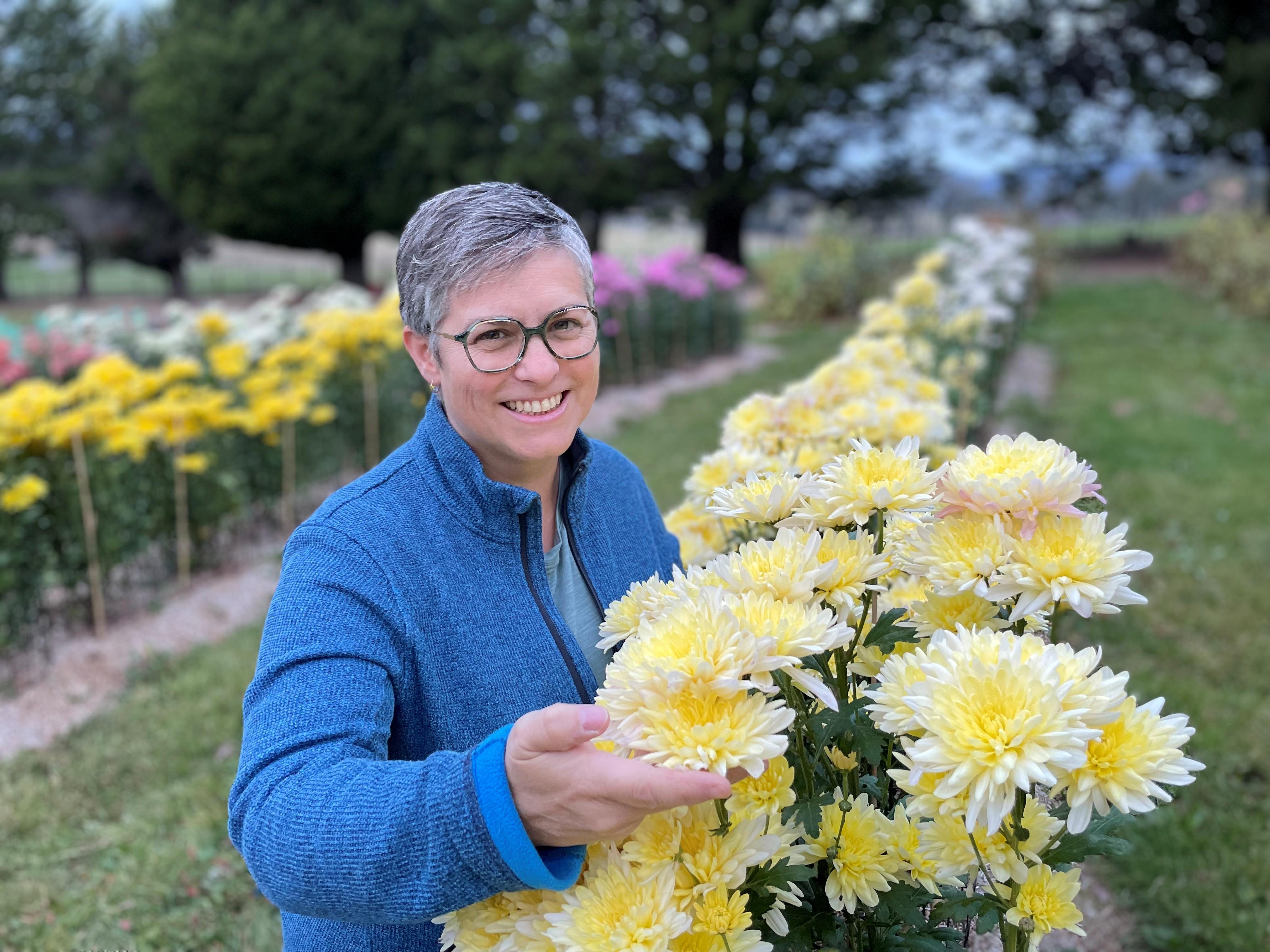
Finallying setting into their new life in 2023, Donna was quick to establish a flower farm called Bloom ’n’ Wonder, growing chrysanthemums and other perennials and annuals, to sell at a roadside stall while working as a medical receptionist in Lilydale.
Darren, who consults and works on several local farms due to a background in agriculture plus his horticulture knowledge, also decided to hobby farm, and realised that the haskaps from his home country would be ideally suited to the local climate.
Last year he planted four rows of haskaps right next to the flower beds, and another four rows will go in soon to total 160 plants.
“We were lucky that the hard work had been done so we could buy various cultivars to trial and over time I’ll be able to work out which ones grow best here in Karoola,’ Darren said.
“Our first seedlings arrived in January last year and we grew them on in pots and now they’re finally going into the beds – with our first berries appearing last summer.
“It will be another few years before each bush is producing the roughly four kilos of berries we expect, but it’s nice to know they’re doing well so far, and luckily there doesn’t seem to be many wallabies around here because they would be vulnerable when they’re young.”
Haskaps are an early season berry, fruiting in November and well ahead of blueberries.
Tasmania and Victoria’s cool climate are suitable for growing them, but they survive in temperatures down to minus 40C, having originated in Siberia and parts of Russia.
They need different varieties to cross pollinate, a job that will be aided by the bees attracted to Donna’s flowers.
“Different cultivars flower at different times so we have to be careful which ones will work together to keep the bees happy,” Darren said.
“Last year the bushes that grew best were also the first to shut down, plus the fruit flavour could be different between varieties so we have all of that to consider going forward.”
Also factoring into the decision to grow haskaps was the fact that they don’t need a lot of maintenance and next to no fertiliser.
A bit of compost and making sure they don’t have to compete with grass or weeds are the main requirements.
Haskaps are high in vitamin C, potassium, phenolic compounds and other anti-oxidants, and according to the University of Saskatchewan the antioxidant level is far higher than pomegranates, grapes, apples, blue berries and they freeze particularly well.
They are primarily used as a fresh fruit because of its very high health-giving properties In addition to fresh fruit, they’re used for making fruit wine (rated as the closest fruit wine to that of grapes), jams, sorbets, ice-cream, chocolate, marinades and fruit leather as well as being used for liqueurs and as an additive to gin.
The wine made from this juice in Canada has constantly been winning wine taste-offs for fruit wines and one major grower, Le Havre, won a world fruit juice making competition with juice from their berries.
In Canada and America haskaps have been strongly accepted by the restaurant industry for use in desserts and also for making marinades for meat dishes. It holds up particularly well with game meats.
“Interestingly, a speaker at the conference we attended in Canada, said he believed the berry’s biggest future would be in the alcohol industry,” Darren said.
“They are creating wines from the berry in Canada.
“The liqueurs, are in our opinion, sensational. We met one grower who is supplying a major portion of his crop for liqueur making.
“Makers of gin, are infusing their gin with them quite extensively.
“One grower who we met with 40 acres in crop, had a massive harvesting machine running flat out and two refrigerated semi-trailer trucks on stand-by for taking the fruit to market.”




Add new comment