
Fishing - Calamari fishery rebuild and shellfish consumption warning
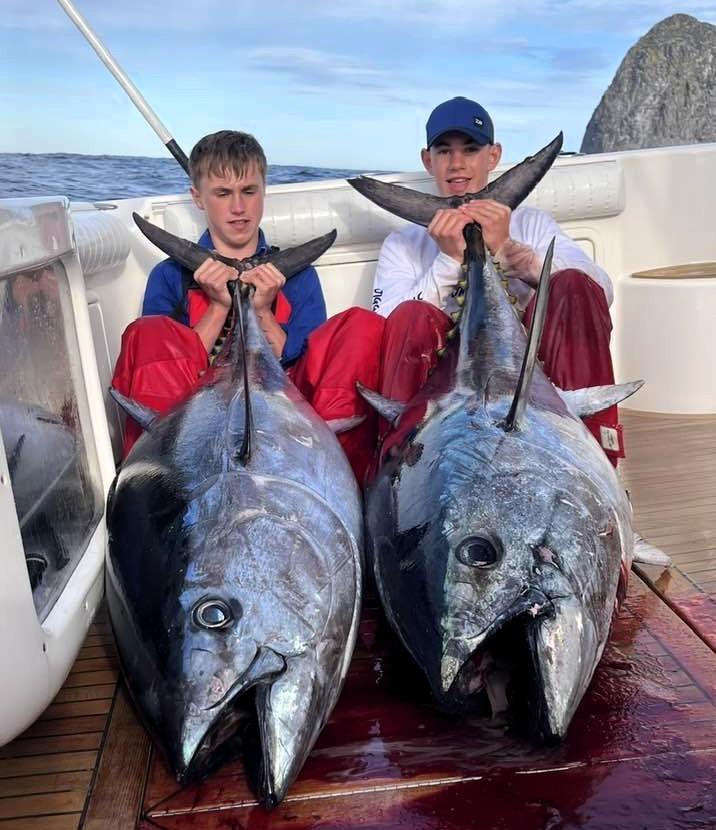
Anglers fishing for Southern Bluefin Tuna are reporting more action with lots of fish seen working schools of bait off the Tasmanian Peninsula during the week.
Anglers have reported seeing cormorants, seals, birds and tuna feeding heavily on schools of redbait.
Hippolyte, the Lanterns, and Mewstone Rock/Island have been mentioned the most.
And after losing a big tuna the weekend before last, Reid Hooker, his son Flynn, and mate Jack Frost went back out on Saturday, and it paid off.
The crew of three caught 26 SBT tuna, including two barrels in the 90 kg-100 kg weight range.
The larger tuna were caught trolling skirted lures, and around a dozen fish were also caught casting topwater "stick bait" lures into schools of feeding fish.
Reid said it was the best trip he's had for numbers caught, and at its best, "you couldn't troll for more than 5 minutes without getting a hookup".
To cap it off, the crew also caught some big Striped Trumpeter.
The Southern Gamefish Club is hosting the Far South Classic this Saturday and Sunday off Southport.
Anglers will be targeting Tuna, Shark and Swordfish from 7 am - 4 pm on Saturday and from 7 am - 1 pm on Sunday, with an award presentation at the Southport Hotel at 3.30 pm.
Southern Calamari populations in the North and South East of Tasmania are depleted, with scientists and anglers working together to understand them better and help rebuild and sustainably manage the fishery.
A key aspect to examine is their spawning patterns.
Over three years, scientists from the University of Tasmania’s Institute for Marine and Antarctic Studies (IMAS) will examine how environmental conditions and fishing activity affect calamari spawning across the state.
IMAS researchers will start monthly surveys in July 2026 using diver-based and towed-video methods in the Northeast, Northwest and Southeast.
Traditional dive surveys will be used to measure squid egg mop density, as well as new cost‑effective monitoring tools such as towed video surveys.
Artificial intelligence training will also detect egg mops from the data and then map regional differences during prime spawning time.
Commercial anglers will also take part, helping to collect biological samples from adult females to determine maturity stages and general activity.
Targets are to assess and monitor changes in spawning activity (North vs. Southeast coasts) in response to climate variability and to provide practical recommendations for adaptive management to state government fisheries managers, especially regarding regionally specific spawning closures.
Fisheries Tasmania has advised not to eat wild shellfish from White Beach in Southeast Tasmania.
This includes waters in and around White Beach and Nubeena on the Tasman Peninsula, and is due to elevated biotoxin levels.
Wild shellfish include oysters, mussels, clams, pipis, cockles, wedge shells, abalone, periwinkles and scallop roe.
The intestines and livers (tomalley) of rock lobster can also be affected when toxic algal blooms are present.
It is safe to eat commercial seafood sold in shops and restaurants, with commercially harvested seafood subject to monitoring, controls and restrictions.
Tip Of The Week - Responsible recreational anglers respect fish and fisheries, bag limits and catch, release and keep practices.
If a fish or two is kept, large fish, nothing goes to waste, as it feeds multiple people, families, and friends.
Send in your fishing reports, pics and tips to valleyfishes@gmail.com
Tight Lines until next week.




Add new comment