
Livestock job looking good, despite increasing costs
As we all know, livestock prices are in a pretty good space and added to good wool prices everything looks pretty exciting.
But I am sure that most livestock producers will tell you that there are some pressures not seen for many years which are dramatically affecting the bottom line (profit).
Interest rates are now at the highest level since 2011 and this doesn’t just affect the farmer but also everyone else in the supply chain and that in turn flows back to the farmer in a negative way.
ABARES data says that in the 2024-25 year interest accounted for 7.5% of total cash costs and that being the case the costs now in 2026 would be considerably higher.
Added to higher interest rates, we have extremely high fuel prices which will put massive pressure on cropping programs and reportedly is meaning than some croppers are seriously looking at replacing crops with livestock.
And to top it all off, just about everything else that farmers buy has also gone up in price.
This is not to be too negative but fact and we are lucky that cattle, lambs and mutton prices are all in very good shape because if this weren’t the case there would be trouble.
There was very good rain through Northern Tasmania, most of Victoria, South East South Australia and Southern NSW over the last week which will reshape the spring in these areas.
Already we have seen store cattle prices improve in Victoria and at Wagga on Monday. Store lamb prices are the other interesting one with most making $190 to $250 at Bendigo on Monday and up to $280 going to the feedlots.
The new season lamb numbers in the early areas like Bendigo, Corowa, Dubbo and Wagga have been quite a bit less than last year which has helped keep the overall prices higher than many expected.
The seasons will play a part in the numbers of store light lambs coming to the market and many producers in marginal rainfall areas will have the decision to make of taking a good early price or punt that the season improves and they can put more weight on their lambs.
Locally it is still a few weeks away from seeing any number of new lambs but any that we are seeing in the saleyards are attracting very strong competition and on Tuesday at Powranna they made $238 to $298/head.
One would think that local lamb finishers will find the interstate prices too high and so will have to buy locally which will make for interesting reading when we start to get a few come to the market.
New season lambs offered
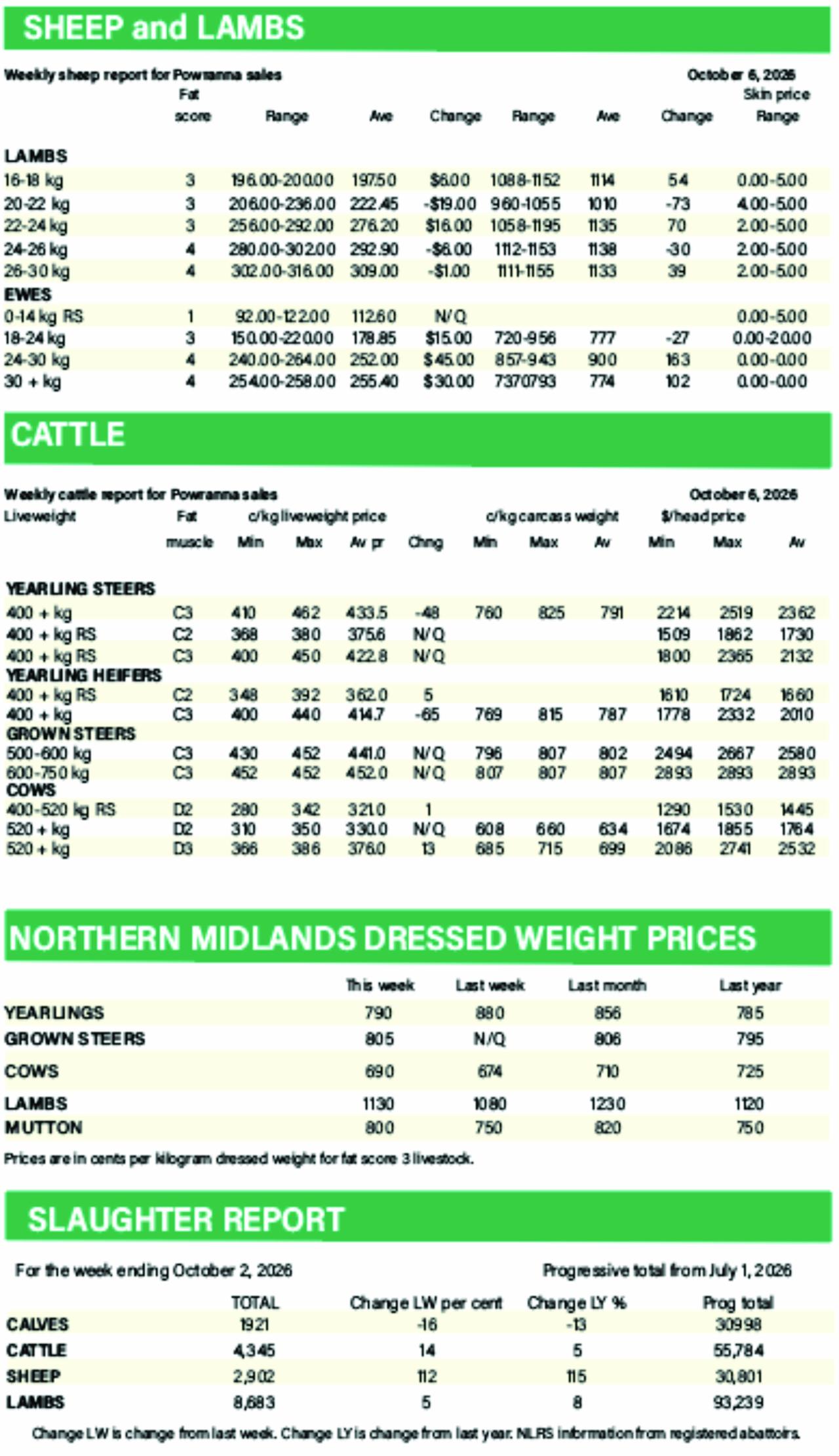
There was a smaller yarding of 364 lambs at Powranna on Tuesday with fewer light lambs and a better selection of trade and heavy lambs.
There were a few pens of new-season lambs and these made $238 to $298 while heavy old lambs made $280 to $316, trade $206 to $292 and light $180 to $200/head.
There were 523 mutton (307 more) and all sheep met a stronger market and heavy sheep made $240 to $260 and medium $150 to $220 while restockers paid $92 to $112 for light ewes and wethers.
There was a similar number of 91 trade and export cattle with quality being very mixed.
Most trade cattle were cheaper with fewer buyers and poorer quality.
Yearling steers made 400c to 462c and heifers 400c to 440c while secondary steers made 330c to 380c and heifers 348c to 392c with most going back to the paddock.
The few grown steers and bullocks made 430c to 452c while the small number of 20 cows sold to stronger market.
Heavy cows made 366c to 386c while leaner cows made 280c to 342c with most going back to the paddock.




Add new comment