
Sticky solution to beat mildew
GRAPE growers in cooler climate regions are starting to switch from using powdered sulphur fungicide to a new liquid option to provide protection against powdery mildew.
Thiopron is proving to be a unique, easy-to-use, advanced liquid sulphur formulation from UPL offering greater coverage and adherence to leaves, better rainfastness and faster activation under cooler temperatures.
The Group M2 multisite fungicide features a built-in, superior adjuvant, Xanthane, which helps to spread and “stick” the sulphur particles on the leaf surface.
Typical water-dispersible granule (WG) sulphur products contain mixed size particles varying from 2-5 micron, whereas Thiopron’s suspended concentrate (SC) formulation contains a smaller, uniform particle size of 1.2 microns, which aids improved conversion of the particles into a vapour.
The SC formulation, containing 825 grams per litre of sulphur, also allows excellent dispersion and suspensibility, making it easy to use, handle and store.
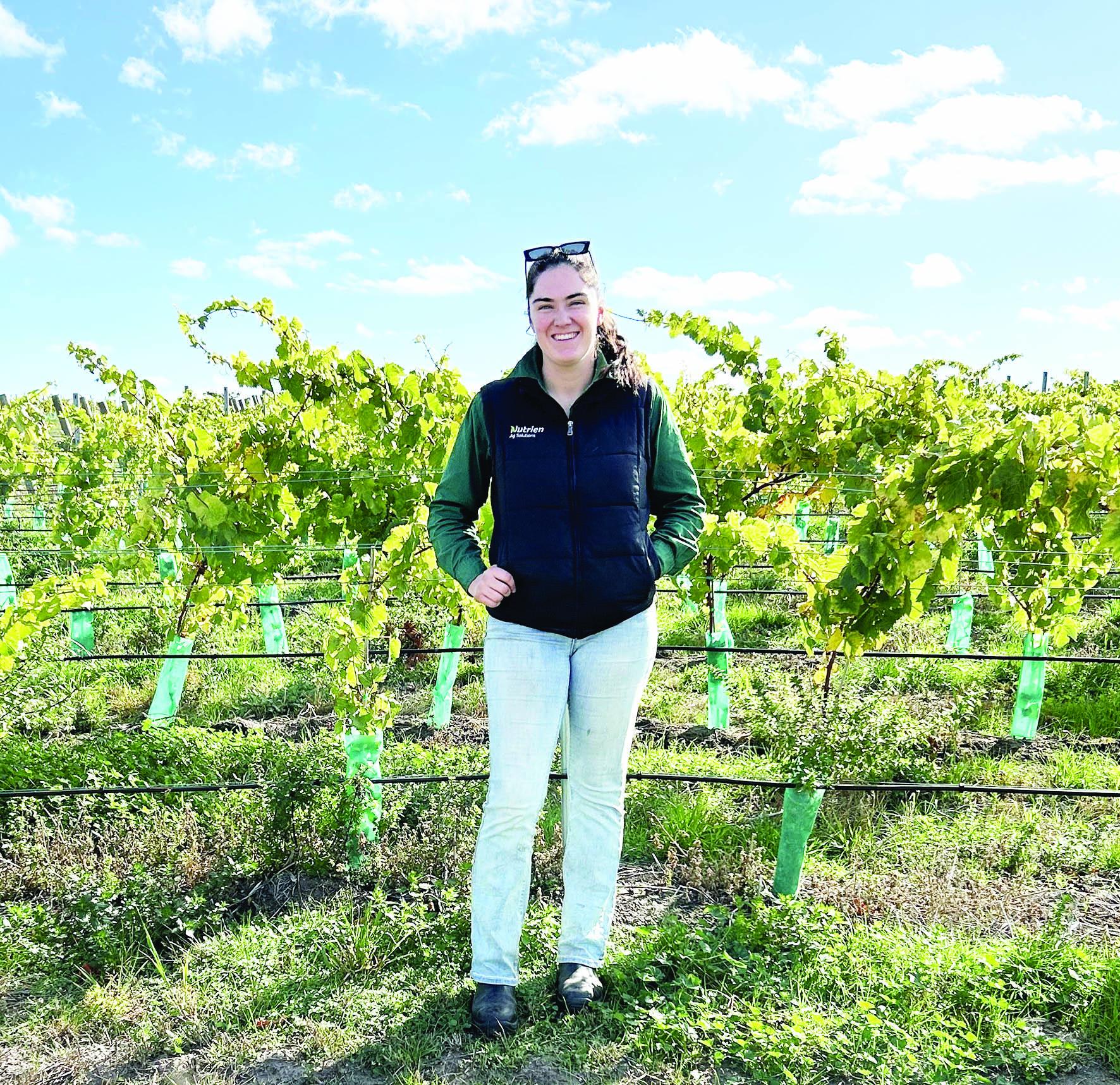
Charlotte Youngman, a junior agronomist working with the experienced Rod Hancl at Nutrien Bridgewater, said many growers in the state’s southern region had switched from wettable sulphur to Thiopron for their first two to four sprays of the season.
The store supports growers through the Coal River Valley, Derwent Valley and East Coast areas up to Swansea in the southern region, where powdery mildew is more of a factor.
Originally from Launceston, Charlotte said they were introduced to Thiopron by Ashlin Rodman from UPL and they were impressed with its characteristics.
“It activates at lower temperatures than the wettable sulphur, so it’s able to work a lot better in the colder climate,” Charlotte said.
“Coming out of winter in Tasmania, temperatures sit a lot colder, especially in the South, and you want to have that protection.”
Rod said wettable sulphur relied more on contact during cooler temperatures, so Thiopron offered a distinct advantage in these conditions.
He said wettable sulphur products also didn’t incorporate a “sticker”, whereas the Xanthane adjuvant in Thiopron provided better rainfastness and longer protection, allowing a longer interval between sprays.
“It stays on the plant for a lot longer. We normally spray at 10 to 14-day intervals, but with Thiopron, we probably have some protection leftover from previous sprays,” Rod said.
Charlotte said the smaller micron helped to cover the leaf better and the Xanthane “sticker” was so good that growers had to spend a little more time cleaning their spray tanks.
“It works better and sticks better, and we can get quite a bit of rain in spring, so growers have been happy to switch for their early season sprays.”
“The wettable sulphurs also require good agitation and some growers have older equipment that doesn’t have that agitation, so they are happy with it being in solution with Thiopron.”



Add new comment