
Sumich field operations manager Ivan Garton among those planting onions
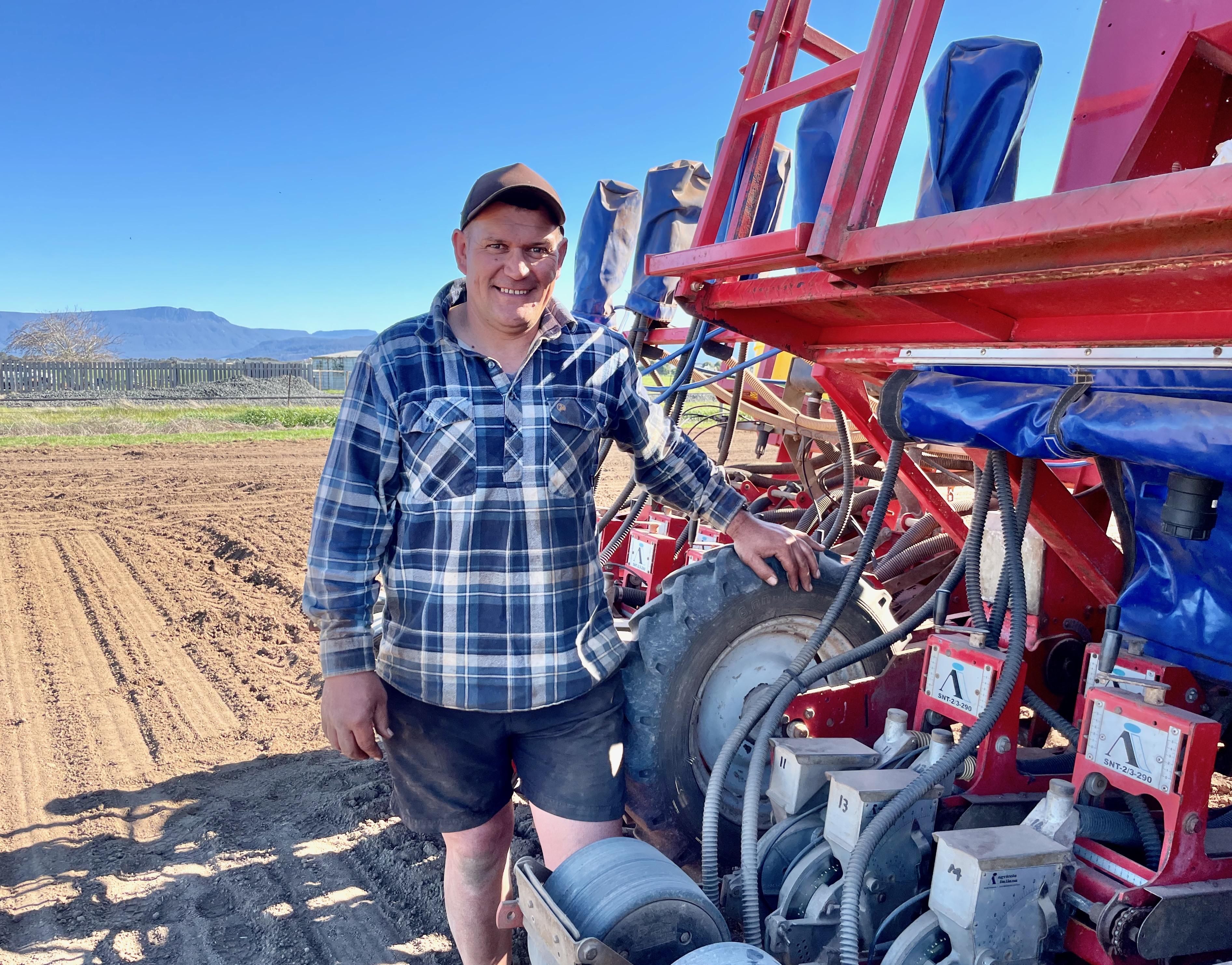
Not everyone can imagine 12 hours a day in a tractor drilling onions, with not even a radio on for company.
But Ivan Garton of Ulverstone has been doing just that for the past 20 years, revelling in the confinement and solitude of the cab and content to listen to the motor chugging away.
As the field operations manager for Sumich, the Western Australia-based vegetable supplier with a satellite operation in Forth, near Devonport, Ivan manages the company’s north-west farms.
Some are owned by Sumich while others are leased to predominantly grow carrots and onions, although some poppies, wheat and barley are also in the mix.
Ivan started out as a tree feller in the forestry industry before Gunns collapsed, prompting a career change to agriculture.
This week he's busy sowing red and brown onions at Bishopsbourne, drilling neat rows and concentrating on the sounds of the drilling equipment to quickly pick up on any issues as they arise.
Following on from early onions it’s now bulk planting time, and with exceptional weather conditions planting continues to go smoothly.
The paddock on Greg Gibson’s farm, Willowvale, where he was working when Tas Country dropped by, is leased to Sumich, with the onions set to supply Woolworths interstate (not Tasmania) and the European market in its off-season.
“This is a 20-hectare paddock and I’m putting both red and brown onions in the ground side-by-side,’ Ivan said.
“The red onions will mature first and be ready for harvest just after Christmas, perhaps early to mid-January, then the rest will follow later.
“We usually get about 80-100 tonnes per hectare, but onions can be a bit finicky to grow - they don't like too much rain or cold snaps.”
Onions are also a fairly intensive, and expensive crop to put in, requiring a good deal of soil preparation.
Each paddock is sprayed, then ploughed, then fertilised, then power harrowed and then finally Ivan comes in for the final step of drilling.
“Each phase takes about an hour per hectare on the tractor, so for this paddock 20 hours of tractor work, five times over,” Ivan said.
“Each seed is drilled exactly 75mm apart - any closer and the onions are smaller, any wider and they grow bigger, filling the gap until they touch.
“During grading any small onions are put aside to use for pickling.”
Once drilling is finished the irrigator is quickly on the scene.
Sumich, which has growing areas in Kwinana, Gingin and Lancelin in WA, expanded to Tasmania in 2013 primarily to establish a carrot plant at Forth while also acquiring onion packer and exporter Field Fresh from Webster Ltd.
Sumich onion field officer Craig Soward, known as much for his farm machinery photography as his ability to grow vegetables, said the quality of Tasmanian onions is second to none - even its major competitor, New Zealand where the crops of Canterbury Plains set a high standard.
“As a worldwide commodity a lot are exported and we’re at the mercy of the global market - but everyone wants onions as a staple vegetable and if they are good quality when they’re picked then there’s a better chance of retaining quality in storage,” he said.
“The more layers of onion skin there are the better they keep.”
He said the planting season had started well, a bit earlier than the past two years, and with hot and dry conditions in Europe, where there’s not the amount of irrigation as in Australia, demand should be high.
“But it’s early days and while the dry start means farmers are already irrigating, there’s nothing to say we won’t get a storm later in the year when we really don’t want it and that could cause damage.
“There’s been some wind about that’s made spraying difficult at times and some nights when we thought the wind would drop out it hasn’t and we couldn't get on.”
Fungal disease is the biggest enemy of onions and while it’s more prevalent on the north-west coast where there’s more moisture than around the northern midlands, controlling fungus is crucial.
Tasmania and South Australia are the biggest onion producers in Australia, making up 67 percent of the total national crop. Tasmania alone provides over one-fifth of this total and a bit over half of the state’s onions are exported.
Key markets for Tasmania are Thailand, Malaysia, Taiwan, Netherlands and Belgium.



Add new comment